


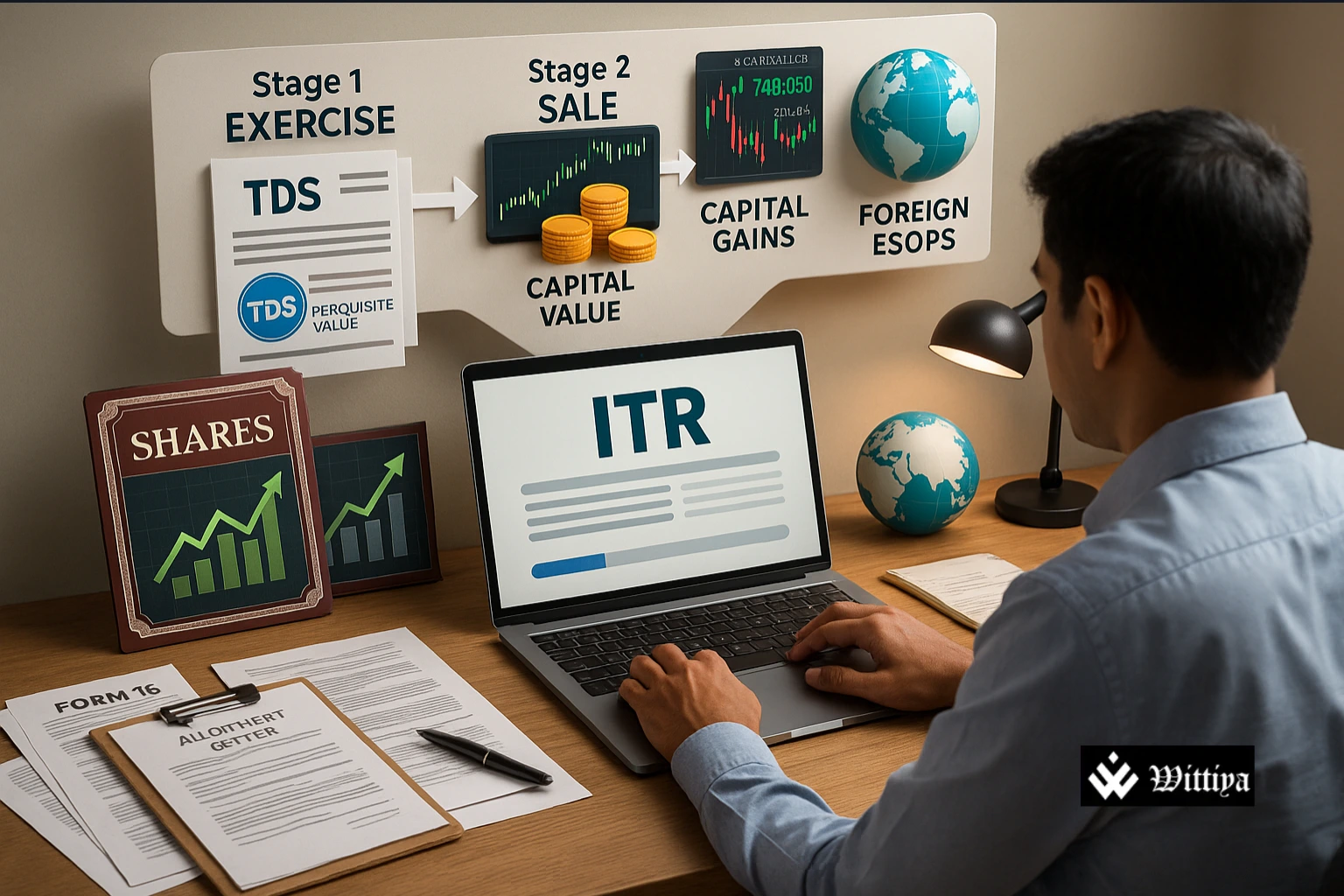
Salaried employees in India must report Employee Stock Option Plans (ESOPs) accurately to comply with tax rules. This guide details step-by-step reporting of ESOP perquisites and capital gains, including foreign shares, ensuring correct disclosure in your ITR and minimizing tax notices.
India’s salaried employees holding Employee Stock Option Plans (ESOPs) need to carefully report these benefits in their income tax returns to avoid mismatches, notices, or interest. ESOPs attract tax at two points — on exercise and on sale — making accurate disclosure critical.
Understanding ESOP Taxation
ESOP taxation occurs at two stages:
- Exercise of Options – When you exercise your options, the difference between the Fair Market Value (FMV) on the exercise date and the exercise price is considered a perquisite. This amount is added to your salary, and your employer deducts TDS accordingly.
- Sale of Shares – When you sell the shares, capital gains tax applies on the difference between the sale price and FMV at exercise. The holding period starts from the allotment date. For tax purposes, the FMV used during exercise is treated as the cost of acquisition. Depending on whether the shares are listed or unlisted, and the holding period, gains may be classified as short-term or long-term.
Step 1 — Collect Necessary Documents
Employees should gather:
- Form 16 reflecting the perquisite value and TDS
- Employer letter stating perquisite calculation
- Allotment date, FMV at exercise, and exercise price
- Broker confirmations and sales statements
If TDS was under-deducted or not deducted, pay the shortfall while filing your return. For capital gains, calculate the sale consideration, subtract FMV at exercise as the cost of acquisition, and classify gains as short-term or long-term based on holding period.
Also Read: India Opens ITR Portal for AY2025–26: A First-Timer’s Guide to Filing
Step 2 — Reporting ESOPs in ITR
- Perquisites: Include ESOP perquisite under “Income from Salary” in your ITR, matching the Form 16 value. Report employer TDS in the tax credit section.
- Capital Gains: Report share sale gains under the “Capital Gains” schedule, using FMV at exercise as the cost of acquisition. Provide allotment and sale dates accurately.
- Foreign ESOPs: Disclose foreign shares or overseas ESOPs under Schedule FA. Apply DTAA or foreign tax credit rules as applicable.
Also Read: India’s Revised Income Tax Bill 2025 Hits Parliament Today — What You Must Know
End-of-Period Checks and Documentation
- Verify TDS and income reported against Form 16, broker statements, and bank records.
- For ESOPs of notified start-ups under deferral schemes, ensure eligibility and disclosure compliance.
- Maintain all supporting documents — valuation reports, allotment letters, ledger entries — for at least eight years.
FAQs
Q1: What cost should I use for capital gains computation on ESOPs?
Use the FMV at the time of exercise, which was taxed as a perquisite.
Q2: What if my employer didn’t deduct TDS on exercise?
Compute the perquisite tax, pay any shortfall (including interest, if applicable), and submit the self-assessment challan with your ITR.
Q3: How do I report foreign ESOPs?
Declare foreign ESOP holdings and income under Schedule FA. Retain detailed valuation documents and claim DTAA or foreign tax credits where applicable.
Key Takeaway
Proper documentation and accurate reporting of ESOPs in income tax returns help employees avoid compliance issues and optimize tax outcomes. Salaried taxpayers should closely track exercise and sale events, report perquisites and capital gains accurately, and maintain supporting documents for future assessments.
READ MORE ON