






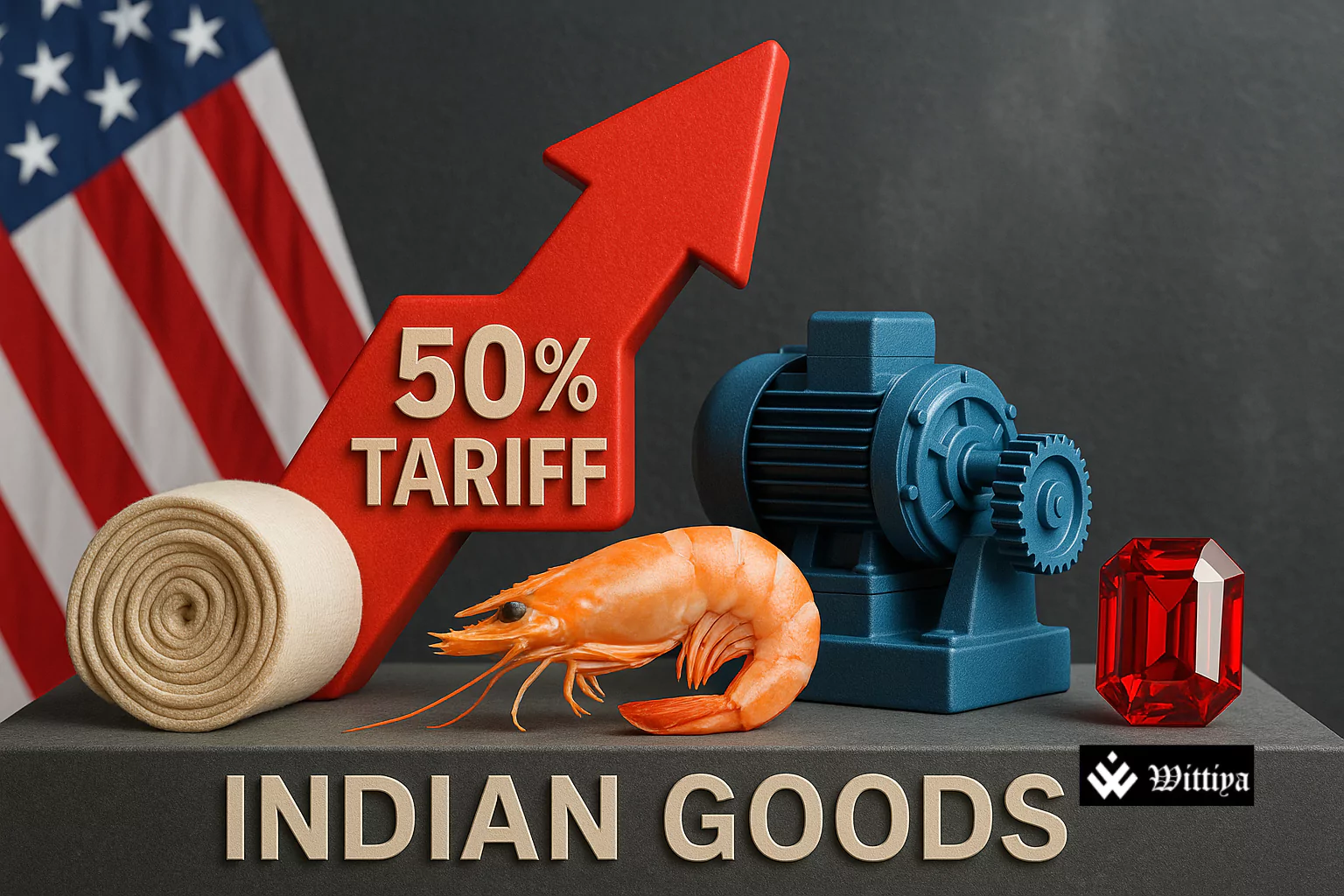
India’s export-driven industries are facing severe strain as the United States enforces a 50% tariff on key goods. Sectors such as textiles, shrimp, gems, and machinery are now grappling with higher landed costs, rising cancellation of orders, and shrinking profit margins.
The United States’ imposition of a 50% import tariff on a wide range of Indian goods has cast a shadow over India’s $450+ billion export economy. This development adds a layer of complexity to India’s trade policy, with repercussions primarily in labor-intensive sectors dominated by Micro, Small, and Medium Enterprises (MSMEs).
The decision — part of a broader geopolitical recalibration — impacts over $30 billion worth of Indian exports annually. Industry associations such as the Federation of Indian Export Organisations (FIEO) and Export Promotion Councils are flagging the tariff as a potential long-term risk to global market competitiveness.
Sector-Wise Breakdown of Tariff Impact
| Sector | US Export Value (FY25) | Previous Tariff | New Total Tariff | Expected Export Decline |
| Textiles & Apparel | $10.3 Billion | 13.9% | Up to 63.9% | 40–50% |
| Shrimp & Seafood | $7.2 Billion | 8.26% | ~33.26% | 35–45% |
| Gems & Jewellery | $12 Billion | ~2% | ~52% | 25–30% |
| Leather & Footwear | $1.18 Billion | 12% | ~62% | 30–40% |
| Machinery & Electronics | $9 Billion | 7% | 50–55% | 20–30% |
Textiles and Apparel: Losing Global Edge
The U.S. is India’s largest buyer of apparel. With the new 50% duty (in addition to existing 13.9%), Indian-made garments now face total landed costs up to 63.9%. The Apparel Export Promotion Council (AEPC) warns this could divert contracts to lower-cost suppliers in Vietnam, Bangladesh, and Mexico.
“Even a 10% landed cost difference can re-route global procurement. At 60%+, India’s edge is eliminated.” – Industry Analyst
Also Read: Russia Slams US ‘Neocolonial Agenda’ After Trump Targets India
Shrimp and Seafood: Exporter Panic
Already burdened with anti-dumping and countervailing duties, Indian shrimp now faces 33.26% total duty in the U.S., where India controls over 30% of market share. The Marine Products Export Development Authority (MPEDA) expects order cancellations in the upcoming holiday season.
Gems, Jewellery, Leather: Luxury at Risk
India’s luxury export sector, including cut diamonds, gold jewellery, and high-end leather goods, is seeing order delays and renegotiations. The Gem & Jewellery Export Promotion Council (GJEPC) fears a $3–4 billion hit in FY25 unless a diplomatic resolution occurs.
Machinery and Electronics: Supply Chain Concerns
Capital goods, especially electromechanical appliances and precision machinery, now face tariffs over 50%, threatening India’s role in U.S. industrial supply chains. This will also impact joint ventures and technology-transfer deals currently underway.
Economic Fallout: MSMEs in Crisis
Indian MSMEs contribute to over 45% of total exports, and are the most exposed to tariff disruptions. With declining export volumes, margin erosion, and rising freight and compliance costs, many MSMEs are seeing working capital stress.
“We are seeing finance pullback from exporters. Without interest subvention and tax relief, the sector won’t survive prolonged tariff war,” said a financial expert from a mid-tier export bank.
Policy Response: Time for Diversification
The Indian government is reportedly accelerating trade negotiations with ASEAN, Africa, and Latin America. There’s also increasing discussion about Production-Linked Incentives (PLI) and FTA-led diversification as strategic responses to this tariff shock.
| Strategic Alternatives Being Considered | Timeline |
| Free Trade Agreement with EU & UK | Under Negotiation |
| Expanded Export Subsidy Framework | Expected Q4 FY25 |
| Interest Subvention for MSMEs | Proposal Pending |
| Duty Reimbursement under RoDTEP | Under Evaluation |
Conclusion
The 50% U.S. tariff marks more than a trade dispute—it signals a structural inflection point for Indian exports. Without rapid diversification, stronger trade diplomacy, and enhanced exporter support, India’s position in key sectors risks long-term erosion.
READ MORE ON