






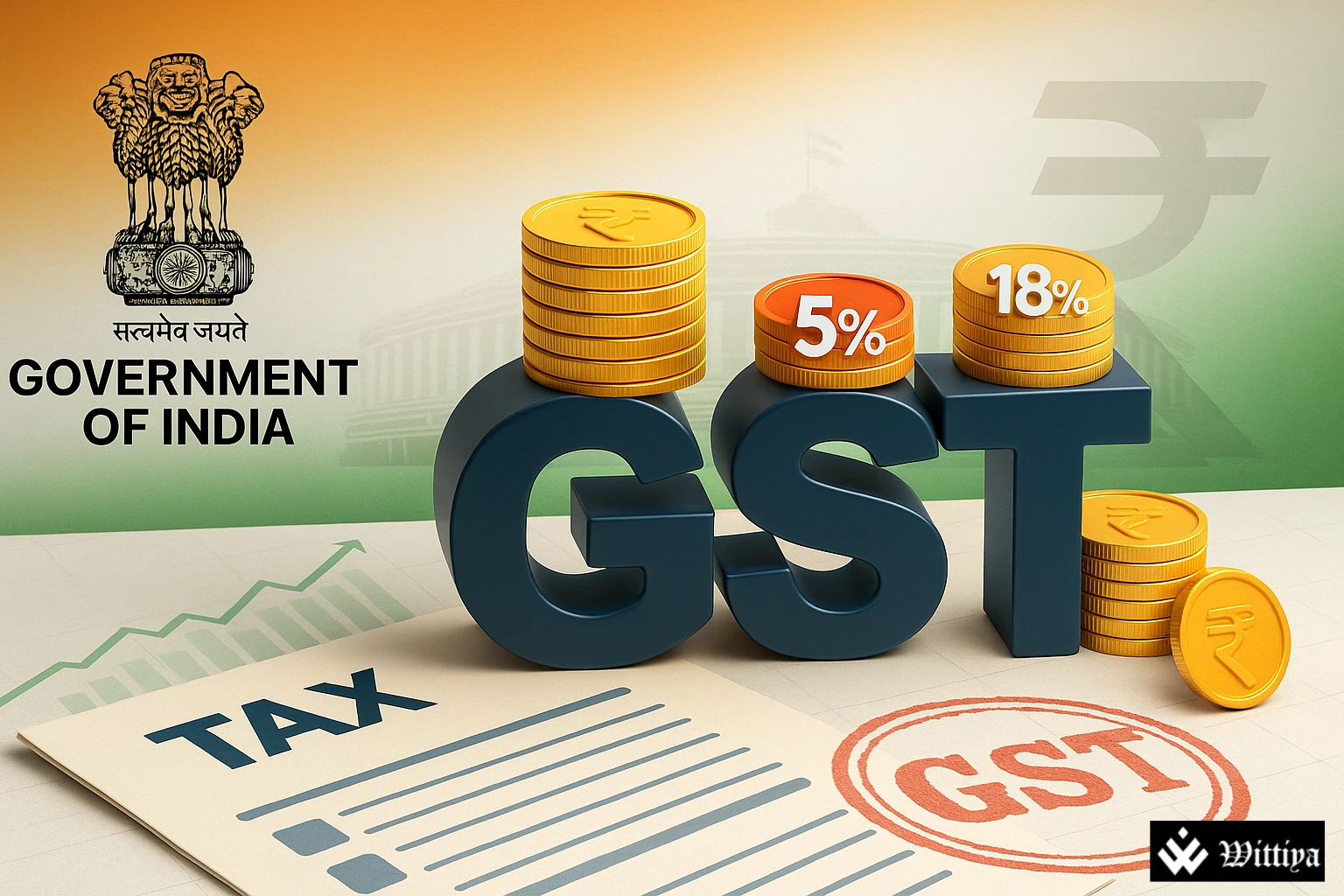
The Government of India is considering a major restructuring of the Goods and Services Tax (GST) framework, proposing a simplified structure with two primary slabs of 5% and 18%. The overhaul aims to ease compliance, rationalize rates, and deliver significant tax relief for consumers and small businesses while maintaining revenue balance.
The Goods and Services Tax (GST) Council, headquartered in New Delhi, oversees India’s indirect taxation framework under the Ministry of Finance. Introduced on July 1, 2017, GST replaced a complex web of indirect taxes with a unified national tax system, intended to simplify compliance, enhance transparency, and create a common market across the country.
In its latest move, the central government is preparing to rationalize the existing tax regime by reducing it to just two slabs—5% and 18%—along with a special 40% rate for luxury and sin goods. According to early indications, nearly 99% of items currently taxed at 12% may shift to the 5% bracket, while about 90% of goods in the 28% slab could move to the 18% category.
Everyday essentials and daily-use products are expected to fall under the 5% rate, reducing the tax burden on households. A special 40% levy will be reserved for seven items, including tobacco, ensuring that sin goods continue to face higher taxation. Notably, the effective tax incidence on tobacco will remain at 88%, keeping its overall burden unchanged.
At present, the GST framework is divided across four major slabs: 5%, 12%, 18%, and 28%. Among these, the 18% category contributes nearly 65% of overall GST collections, while the 28% bracket adds around 11%. The proposed simplification is expected to reduce distortions in pricing, encourage higher consumption, and create greater predictability in tax compliance.
Labour-intensive and export-driven industries, including diamonds and precious stones, are likely to continue under their current tax structure to support global competitiveness. The government expects that the rationalized rates will increase domestic consumption and stimulate economic activity, thereby offsetting potential revenue losses.
In his Independence Day address on August 15, Prime Minister Narendra Modi announced that the next phase of GST reforms would be implemented by Diwali this year. These reforms, he said, are designed to provide substantial relief to the common man and strengthen the financial ecosystem for small and medium enterprises, which form the backbone of India’s economy.
If approved, this GST revamp will mark the most significant change to the indirect tax regime since its inception in 2017, signaling a step towards simplification, fairness, and long-term economic growth.
READ MORE ON