






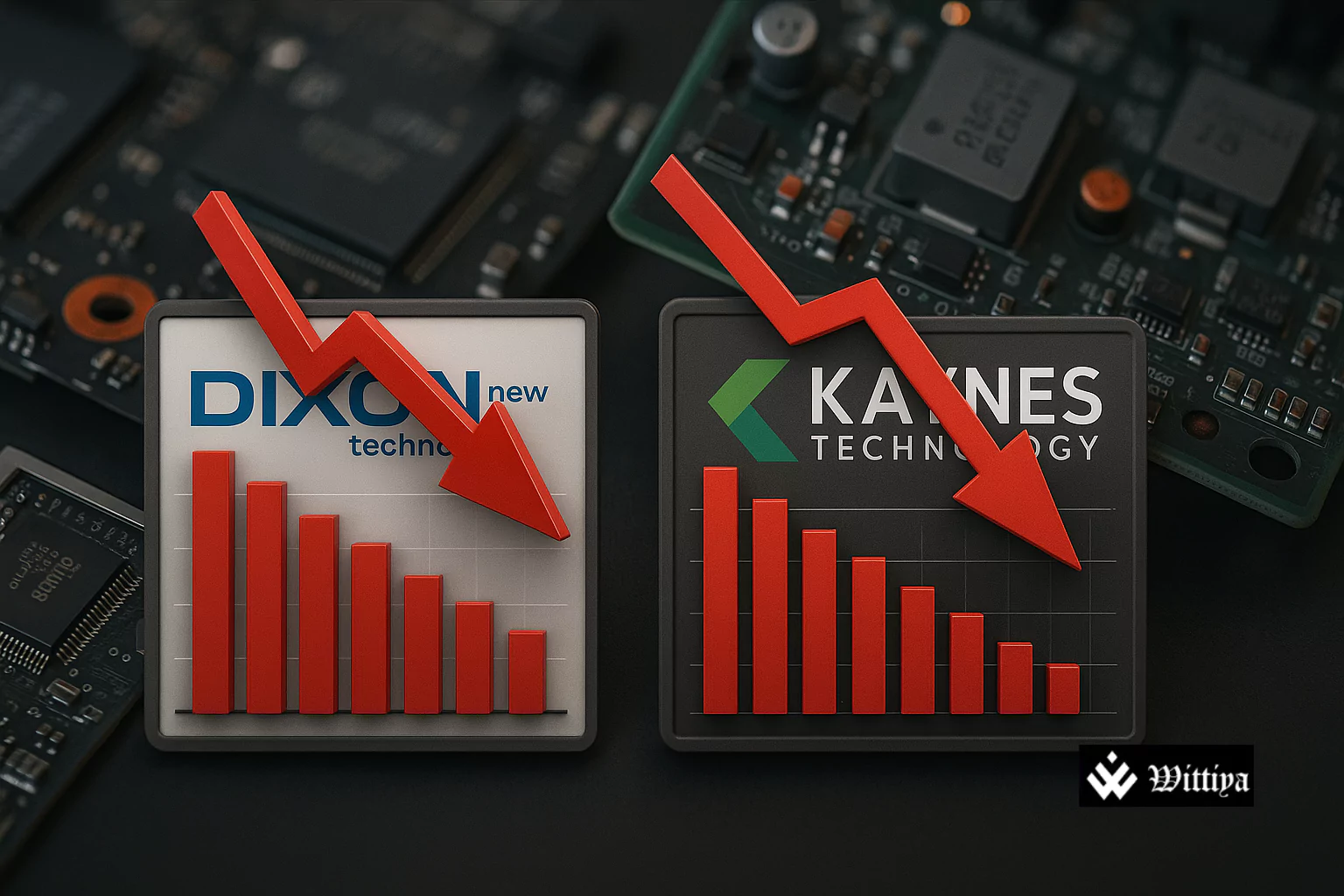
India’s once-booming electronics manufacturing sector, central to the “Make in India” initiative, is witnessing a market pullback as shrinking profit margins, slowing growth, and high valuations dampen investor optimism. Leading companies like Dixon Technologies India Ltd. and Kaynes Technology India Ltd. have seen stock declines of over 15% in 2025, with investor concerns rising ahead of the expiry of key government incentives.
India’s push to become a global manufacturing hub is hitting turbulence, with the country’s electronics manufacturing sector — once the poster child of Prime Minister Narendra Modi’s “Make in India” campaign — facing declining investor confidence.
Electronics manufacturers like Dixon Technologies India Ltd., headquartered in Uttar Pradesh, and Kaynes Technology India Ltd., based in Karnataka, have seen their shares drop more than 15% since the beginning of 2025. The downturn contrasts sharply with their stellar run in past years, where companies posted triple-digit gains, driven by bullish expectations about India’s potential to rival China in manufacturing.
But that optimism is now being tempered. Investors are increasingly wary of shrinking profit margins, the fading effect of government-led incentives, and excessive valuations. For example, Dixon and Kaynes shares had been trading at over 50 times their one-year forward earnings — more than double the valuation of India’s Nifty 50 Index and significantly higher than global peers like Hon Hai Precision Industry Co. and Wistron Corp., which trade at 11–12 times earnings.
Fund managers like Vikas Pershad of M&G Investments note that while revenue potential remains, the combination of stretched valuations and moderating margins makes capital deployment in the sector less appealing.
The recent market correction is partly attributed to the looming expiry of India’s production-linked incentive (PLI) scheme — a critical pillar of Modi’s manufacturing push. With the government silent on possible extensions, speculation is rife that the PLI scheme will lapse due to underwhelming results. Notably, Dixon is expected to be affected once mobile manufacturing incentives end in March 2026.
Meanwhile, companies are pursuing vertical integration to reduce dependency on third-party suppliers — a move raising long-term cost concerns. Kaynes is investing ₹34 billion (approx. USD 397 million) into a semiconductor assembly facility, while Amber Enterprises India Ltd. has pledged up to ₹24 billion toward expanding its electronics business.
The manufacturing headwinds are not confined to electronics alone. Other once-promising segments like renewables and auto components are also showing signs of fatigue. Adding to the strain, Foxconn Technology Group recently called back hundreds of Chinese employees from iPhone plants in southern India, indicating operational shifts.
Analysts like Vipraw Srivastava of PhillipCapital India emphasize that while initial growth was subsidy-driven, the long-term viability of India’s manufacturing push depends on smart capital expenditure and the ability to establish a competitive edge.
As India’s ambition to become the next global manufacturing powerhouse faces its first major reality check, all eyes are on how industry leaders and policymakers will recalibrate for sustained, organic growth.