


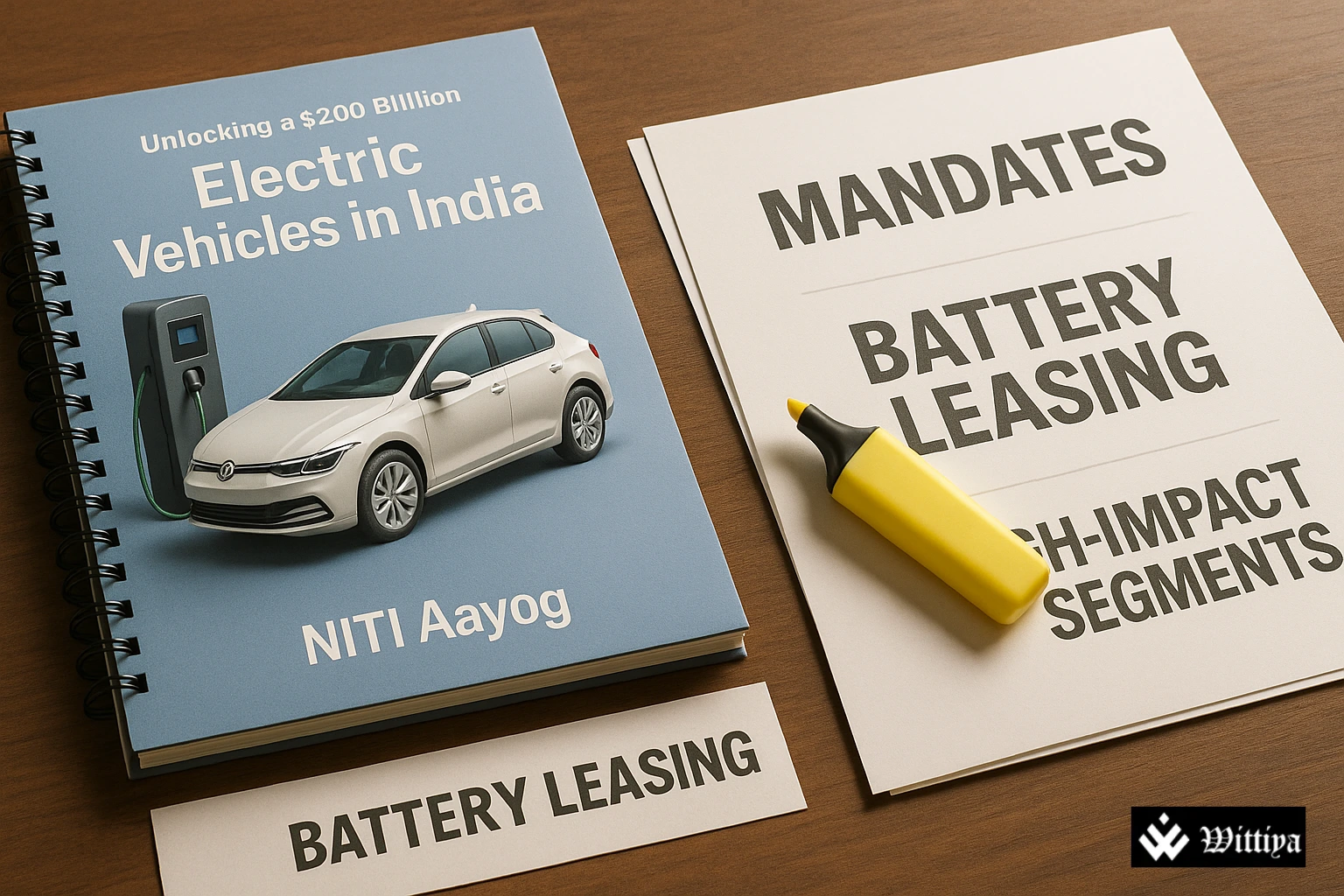
India’s premier policy think tank, NITI Aayog, has outlined a major shift in its electric vehicle adoption strategy, moving from broad-based financial incentives to targeted mandates and disincentives. The strategic transition aims to unlock a $200 billion economic opportunity and place India at the forefront of global electric mobility.
NITI Aayog, headquartered in New Delhi, is the apex public policy institution of the Government of India, tasked with fostering economic growth and sustainable development through evidence-based recommendations. In its latest report titled “Unlocking a $200 Billion Opportunity: Electric Vehicles in India”, the institution advocates for a paradigm shift in the country’s EV strategy—moving away from widespread subsidies and toward more focused mandates and regulatory signals.
The report asserts that relying solely on incentives for Original Equipment Manufacturers (OEMs) will no longer suffice to reach the government’s target of 30% EV sales within the next five years. Instead, NITI Aayog proposes a phased introduction of mandates and disincentives to accelerate adoption without inciting significant resistance.
To minimize backlash, the proposed mandates will initially apply to limited segments of the vehicle fleet—primarily public buses, government fleets, and urban freight vehicles. These segments, although fewer in number, offer higher societal benefits and are easier to manage in terms of compliance.
Also Read: Amitabh Kant Steps Down as G20 Sherpa After 45 Years of Government Service
Key Policy Shifts Recommended by NITI Aayog
| Current Focus | Proposed Transition |
| OEM-centric subsidies | Mandates and light disincentives for select segments |
| Financial support for vehicle ownership | Incentives tied to services delivered (e.g., km run, charging services) |
| Capital cost subsidies for EVs | Battery leasing to reduce upfront costs |
| Uniform national rollout | Saturation-based deployment in high-usage geographies |
| EV support based on vehicle sales | Prioritizing vehicles with high daily utilization |
Another strategic recommendation is to focus on transitioning high-utilization vehicles such as commercial fleets and intra-city delivery trucks. These vehicles cover more kilometers daily and yield greater environmental benefits with limited need for widespread charging infrastructure. Conversely, personal electric cars are deprioritized due to their low usage rates and share in the vehicle mix.
To support adoption among high-impact segments, the report emphasizes the need to expand financing options for electric buses and trucks. Despite forming only 4% of India’s vehicle population, these commercial vehicles account for more than 50% of CO₂ and particulate matter emissions, highlighting their significant environmental footprint.
Also Read: Ather Faces Rare Earth Crunch—Is India’s EV Supply Chain at Risk?
Priority Segments for EV Transition
| Segment | Rationale for Priority |
| Public Buses | High daily usage, public benefit, fleet control |
| Urban Freight Vehicles | Frequent usage, predictable routes |
| Government Vehicles | Centralized control, policy leverage |
| Commercial Trucks | High emissions contribution, financing needed |
| Personal Cars | Lower priority due to limited daily use and lower fleet share |
A core structural shift proposed is decoupling the EV’s capital cost from its battery cost. As batteries represent up to 40% of an EV’s upfront expense, NITI Aayog recommends promoting a battery leasing ecosystem. In this model, users could lease batteries and pay either monthly or based on usage (per kilometer), thereby making EV ownership more financially accessible and attractive for lenders.
Additionally, the report advocates for greater investment in R&D to enhance battery energy density and reduce dependency on imports. It positions India as a potential global battery innovation hub—provided the country accelerates innovation in this space.
Also Read: India Eyes Top 3 Global Spot After Surpassing Japan in GDP
Charging infrastructure, too, is a key consideration. Rather than aiming for equal distribution across the country, the report supports developing dense charging networks in high-priority regions such as highways and freight corridors. It also calls for simplifying electricity connections through power distribution companies to ensure rapid deployment of EV charging stations.
Contrary to assumptions that a higher density of charging infrastructure directly correlates with EV adoption, the report highlights Norway’s example—where strategic mandates helped the country achieve 93% EV penetration despite having a relatively poor charger-to-vehicle ratio. This signals that policy ambition and early mandates may outweigh infrastructure density in driving electric mobility.
Overall, the report provides a comprehensive roadmap that signals India’s shift from early-stage incentive-based support to long-term structural alignment of markets, policy, and public benefit.
READ MORE ON