







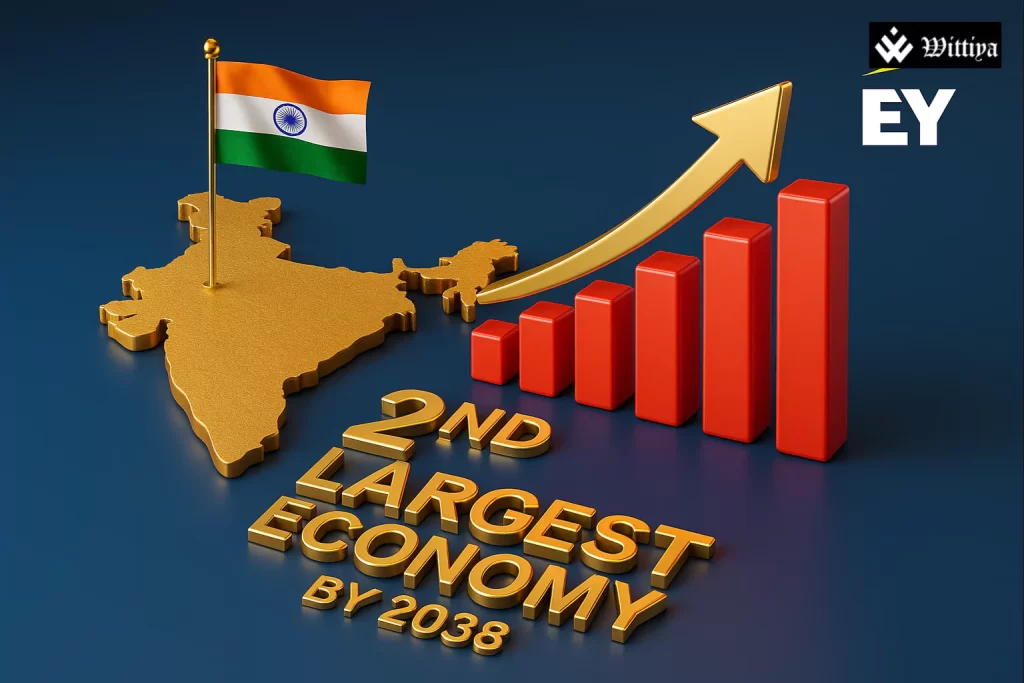
The young population of India along with rising domestic demand and fiscal strength of the country are the main reasons behind India being projected by EY to become the world’s second-largest economy by 2038.
According to the EY Economy Watch report, India is on the countdown to becoming the world’s second-largest economy by 2038. Among other things, India’s demographic, strong domestic consumption, fiscal discipline, and structural reforms are the reasons that have kept the country ahead of many of its global peers.
Reasons for India to be 2nd Largest Economy by 2038
The report identifies India as the country with the most ideal population-related factors. The median age in India is projected to stand at 28.8 years in 2025 which is way less than that of the developed economies like Japan, Germany, or China. Hence, the country will have a large, young, and productive workforce to drive output, consumption, and innovation at least for the next twenty years.
What’s more, India is one of the major economies with the highest savings rate which translates into a huge fund pool for investment in infrastructure, industrial base, and startups. This savings-led investment cycle ensures the long-term capital requirement will come from domestic resources rather than from external borrowing.
Besides, the debt burden of India is a factor that contributes to the country’s economic bright side. While the U.S. and other advanced economies are going in the direction where their public debts are growing bigger, India’s debt-to-GDP ratio is forecasted to go down from 81% in 2024 to approximately 75% by 2030. This turnaround in finance will give the Indian policymakers more leverage to keep up with the momentum of growth and also protect the economy from global shocks.
Also Read: The ‘Dead’ Economy That Refuses to Die: What’s Really Fueling India’s Rise?
India’s Domestic Market Advantage
India, being a country which is not heavily dependent on exports, is less vulnerable to the current uncertainties in the world trade market, as it has a stable domestic demand base. The consumption in India is continuously escalating as the stronger middle class backed by rising earnings and urbanization is proving to be very effective. Decline in international trade is not the end of the world for India as the country can fuel her own growth from internal sources.
The EY report also highlights that India’s domestic demand-led model is less vulnerable to external shocks, e.g., geopolitical trade disputes. To give an instance, the US tariffs which are speculated to be imposed on India may affect no more than 0.9% of India’s GDP; that is why the long-term impact of the tariffs is minimal because of the possibilities of country export diversification and growth promotion from the internal market.
How India Stands with World
Although the story of India’s economy is getting stronger with each passing day, the international competitors face some structural problems:
- China: Aging population and slowly falling birth rate are the factors that threaten the country’s productivity in the long run.
- United States: Heavy public debt and budget deficits continue to raise risks of financial crisis.
- Germany & Japan: Aging populations and their heavy reliance on international trade are two factors that make these countries susceptible to instability.
The combination of India’s youthful population, reforms, and fiscal discipline has put the country in a relatively stronger position. It is estimated that India will surpass Germany to become the third-largest economy in market exchange rate terms by 2028 before further rise in PPP terms by 2038.
EY India’s Chief Policy Advisor, DK Srivastava expresses in particular that the strong fundamentals of India will make it possible for her to fulfill the long-term dreams such as “Viksit Bharat” (developed India) by 2047. He emphasizes that India’s policies are definitely working as the plan for the global economy is fraught with uncertainties.
The Road Ahead: India at $34.2 Trillion
India’s GDP in terms of PPP is forecasted to exceed $34.2 trillion if the country continues to preoccupy itself with growth in the same manner for the next few years until 2038. This achievement would make India second only to China in the list of the largest economies.
Combining fiscal discipline, the demographic dividend, and growing domestic consumption, India is becoming a possible dilemma for the rest of the world in terms of the top ranking of global economic leaders.
FAQ’s
Q1: What distinguishes India’s growth from that of other countries?
India’s youth demographic, a consumption-driven local economy, and a progressing fiscal stance are the factors that keep its growth more resilient than those of the elderly and heavily-indebted economies
Q2: When will India become the third-largest economy in the world in nominal terms?
The forecast is that by 2028, India will surpass Germany to be the third-largest economy in the world in nominal terms.
Q3: How big is the impact of US tariffs on India’s growth?
According to the EY report, the direct exposure of India to US tariffs is only 0.9% of the country’s GDP. It is further stated that the long-term effect of such barriers will be minimal, as India can turn to new trade partners and its domestic market to meet the demand.