







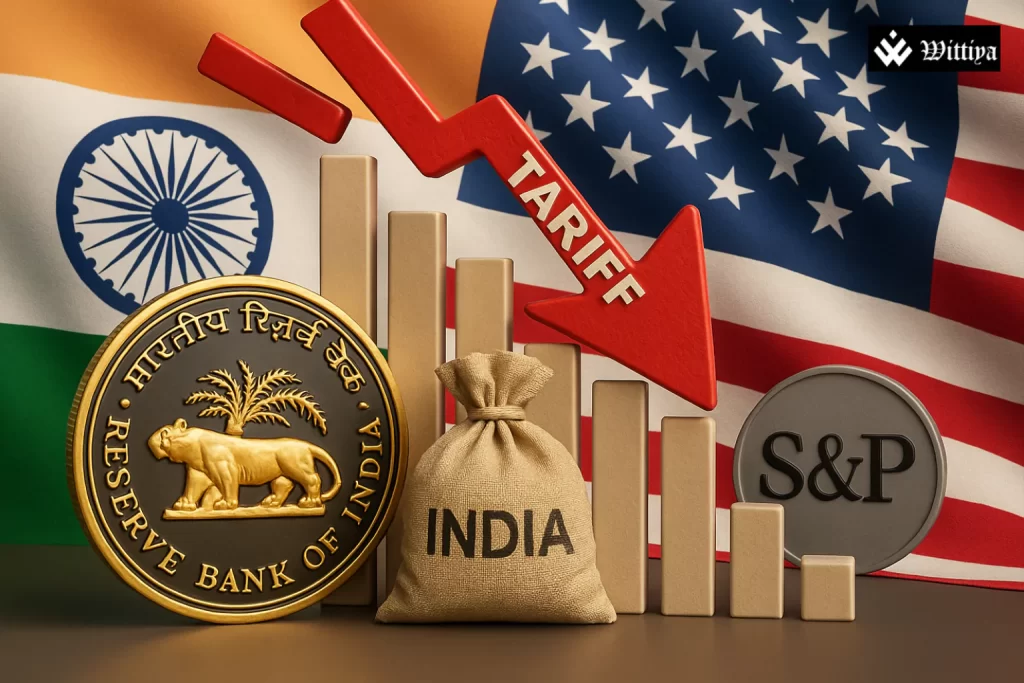
The Reserve Bank of India has issued a warning that the uncertainty about U.S. tariffs could lead to a decline in demand for India even after the easing of the inflation trend and an upgrade of the sovereign rating by S&P, which indicates a positive inflow of capital.
India Tariff Risk Outlook
In its August bulletin, the Reserve Bank of India (RBI) pointed out that the ambiguity in US tariff policies continues to present a major risk on the downside to India’s overall demand outlook. The statement comes when India is generally showing better inflation trends and has got a rating upgrade from the international rating agency S&P.
The bulletin also indicated that the present trajectory of inflation may be less severe than expected initially. However, if there were to be prohibitive tariffs, for instance, the US administration’s 50% levy on Indian products, the resultant export restriction would have a ripple effect on manufacturing and economic activities in general.
Tariff Pressures and India’s Demand Risks
Faced with supply chain issues that have already imposed heavy burdens on the Indian economy, the country is now dealing with more risks related to tariff moves in the US. It is expected that these tariff measures will slow India’s exports, make it less competitive, and reduce the profits of corporate firms in trade-sensitive sectors.
The RBI has been cautionary in tone about how these events may lead to a decrease in the folium demand in India. Given that India’s growth model has been predicated on external trade performance, falling exports over a prolonged time will have a knock-on effect on employment creation and the capital expenditure cycle.
Sovereign Rating Upgrade Brings Relief
The credit prospects of India has been turned for the better following the good news when S&P has upgraded the sovereign rating for India. This change is predicted to facilitate inflows of capital, lower the costs of borrowing, and keep the yield on government bonds rising at stable levels. The capital coming in this way may provide a cushion against the strong winds of tariffs in the coming period.
Experts in the capital markets are of the view that a good foremost sovereign performance would act as a magnet for direct housing inflows as well as foreign portfolio in turn eventually putting against leaving India’s macro-stability amidst external trade challenges.
Also Read: Sensex Rises 450 Pts Amid Tariff Jitters
Inflation and Rural Growth Outlook
Even though it is still a problem, the RBI bulletin made it very clear that the inflationary pressure now facing is much less than before. We can expect a rabi crop that would be of good quality since the rainfall has been normal and the temperature conducive. Besides, the rise in real rural wages would add to the purchasing power of the rural economy of India and hence act as a buffer to the domestic demand.
The central bank has also stated that the consumption in the rural areas supported by the stability of agriculture is the lifeline for the Indian growth that is showing resilience. In the event that food inflation keeps moderating, it is envisaged that the overall inflation will be of manageable levels thus giving flexible policy for the RBI.
Policy Balance Ahead
Tariff risk and rating support are two major factors that have an impact on India’s complex economic outlook. The question is how policy makers who are expected to juggle global trade pressures with the domestic growth imperative will do this. Analysts suggest that while a sovereign rating can give a country a buffer, a US policy of high tariffs might still be able to reduce India’s growth rate in the long term.
The RBI bulletin reports that the emphasis of policy in India should continue to be on supporting domestic demand, at the same time maintaining structural reforms to enhance competitiveness and productivity.
FAQ’s
Q1: Why is RBI concerned about tariff uncertainties?
RBI is concerned that US tariffs, for example, a 50% duty on Indian goods, can have an adverse effect on exports, reduce competitiveness, and weigh on India’s overall demand.
Q2: How does S&P rating upgrade benefit India?
The improvement in the rating strengthens India’s sovereign profile which in turn attracts more foreign capital inflows, reduces the cost of borrowing, and helps the sovereign bond yields to improve.
Q3: What is the role of rural demand in India's economy?
Rural demand, which is led by increasing wages and good crop output, stabilizes domestic consumption and acts as a shock absorber for external trade shocks.
READ MORE ON