






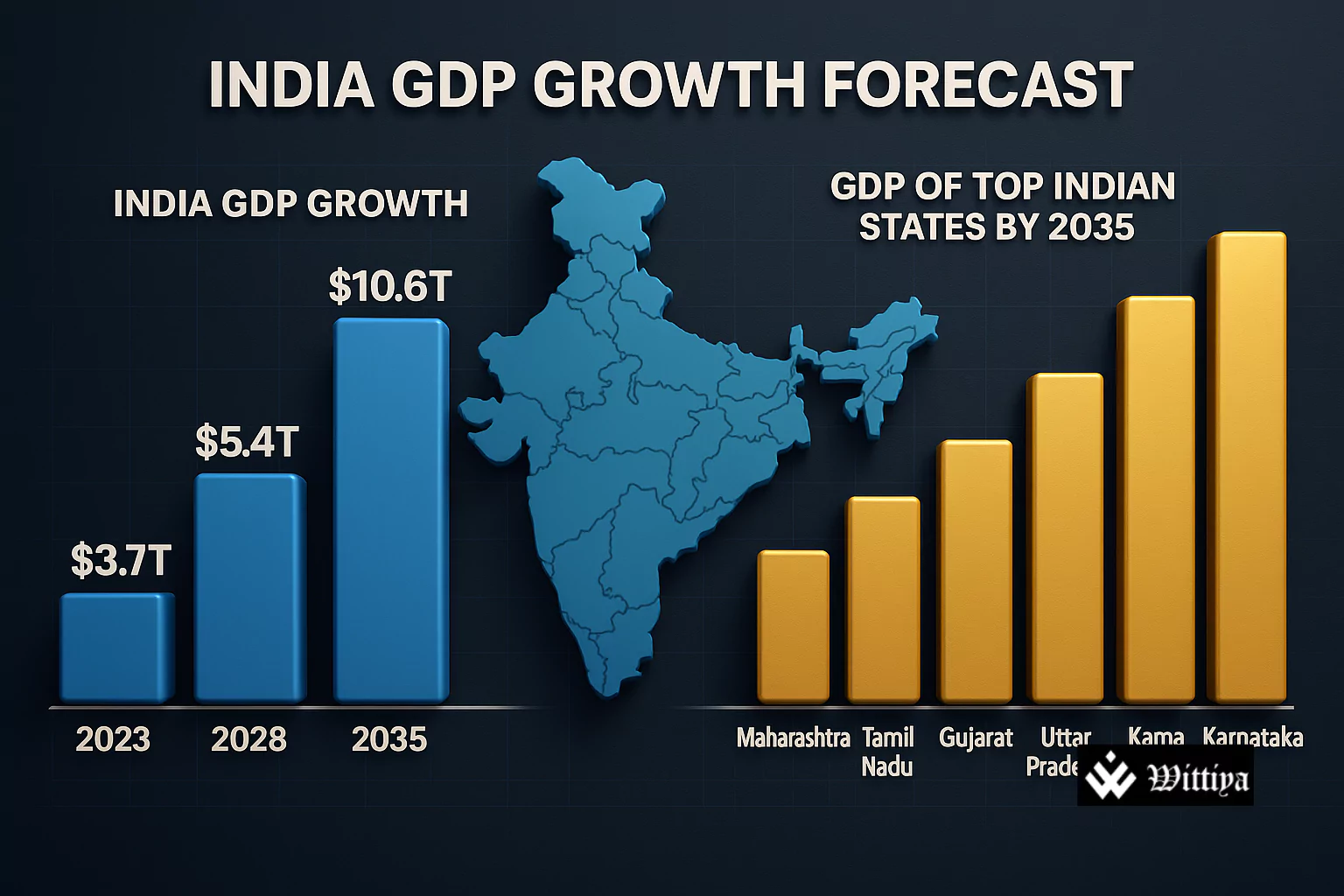
India is poised to become the world’s third-largest economy by 2028 and is projected to double its GDP to $10.6 trillion by 2035. States like Maharashtra, Gujarat, and Tamil Nadu are expected to approach the $1 trillion mark in GDP, reshaping global economic rankings.
India is on a robust path to becoming the world’s third-largest economy by 2028, with its GDP expected to more than double to $10.6 trillion by 2035, according to a recent financial report. This economic leap underscores India’s deep structural transformation and the pivotal role of its states in sustaining long-term growth.
As per projections, three to five Indian states — including Maharashtra, Tamil Nadu, Gujarat, Uttar Pradesh, and Karnataka — could approach the $1 trillion GDP milestone, placing them among the top 20 global economies if ranked independently.
The report identifies Maharashtra, Gujarat, and Telangana as the top contributors based on recent data, while states like Chhattisgarh, Uttar Pradesh, and Madhya Pradesh have demonstrated remarkable progress in economic performance over the past five years.
States as Engines of Economic Ascent
India’s federal structure continues to empower states to act as competitive economic units, tailoring industrial policies, streamlining regulations, and attracting both domestic and global capital. Each investment is ultimately rooted in a specific state, and states have autonomy in managing finances, enhancing ease of doing business, and fostering infrastructure.
This model of “competitive federalism” is critical to India’s economic rise, especially in positioning the country as a global manufacturing hub and doubling per capita income within a decade. It is also expected to support capital market expansion by offering a sustained pipeline of investment-led growth.
Infrastructure: The Backbone of Growth
Over the past decade, India has doubled down on infrastructure spending, with the central government’s capital expenditure rising from 1.6% of GDP in FY15 to 3.2% in FY25. This push has transformed the transport and logistics network—highway coverage is up 60%, the number of airports has doubled, and metro rail infrastructure has expanded fourfold.
These developments have been fueled by national programs such as PM Gati Shakti, National Infrastructure Pipeline, Bharatmala, Sagarmala, and UDAN, supported by state-led initiatives in urban development, power, and water infrastructure.
Such large-scale capital deployment has laid the groundwork for economic acceleration while also creating jobs and fostering urbanization.
India’s Role in Global Growth
India is expected to contribute 20% of global growth over the next decade, highlighting its significance as a growth engine for multinational earnings and global trade rebalancing.
Recent estimates position India’s GDP at $4.187 trillion, placing it ahead of Japan and making it the fourth-largest economy globally. The report emphasizes that fiscal prudence, declining inflation, improved liquidity, and lower government borrowing are key macro tailwinds aiding the momentum.
Additionally, stronger urban household balance sheets, favorable monsoons, and a reviving rural economy further reinforce the growth outlook.
India currently commands a 19% weight in the MSCI Emerging Markets Index, signaling strong investor confidence and alignment with global asset reallocation trends.
Looking Ahead: Collaborative Growth Required
The report concludes that sustained collaboration between the central and state governments will be essential in maintaining this trajectory. As infrastructure investments grow, and states continue to compete and innovate, India stands at a crucial inflection point—ready to reshape the global economic order over the next decade.
READ MORE ON