


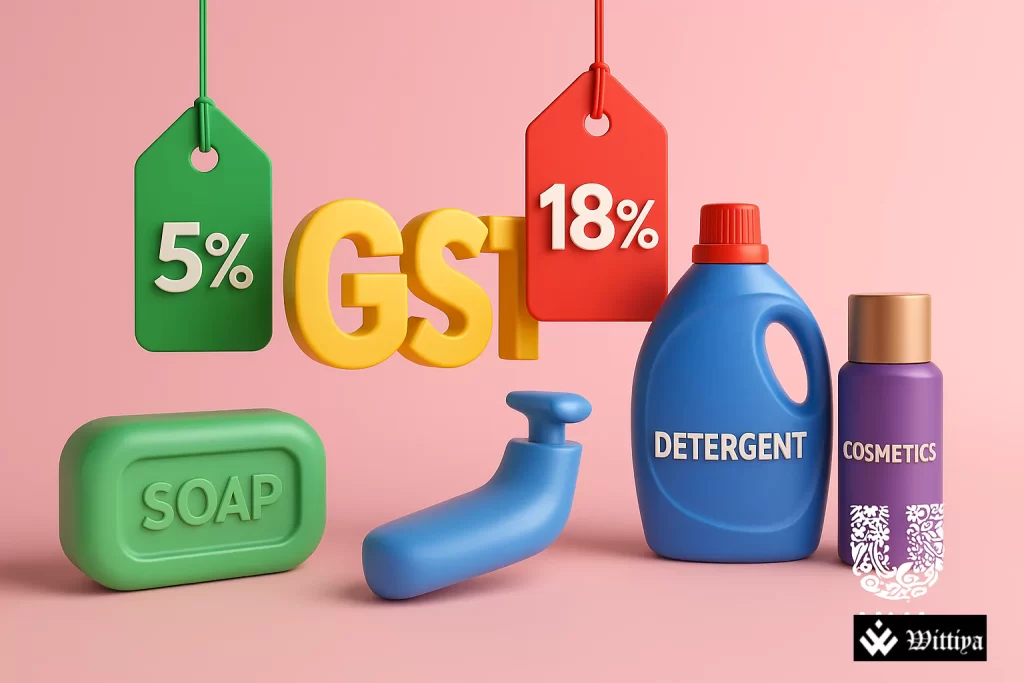
Reducing the GST Council’s slab structure to only two rates has been a welcome change for soaps, shampoos, and toothpaste as it has brought down their rates. Still, detergents and cosmetics have been kept at 18% tax rate. This step has taken FMCG companies aback, as they had anticipated a drop in the rates of all daily-use essentials without exception.
About the FMCG Sector in India
The Fast-Moving Consumer Goods (FMCG) sector in India is the 4th biggest industry and is responsible for a large fraction of the consumption in both urban and rural areas. The conglomerates are situated in several big cities like Mumbai, Gurugram, and Bengaluru and the likes of Hindustan Unilever Limited (HUL), ITC Limited, Godrej Consumer Products, and Procter & Gamble India are the major players in this industry.
The sector mainly comprises household- and personal-care products, which are essential in nature, ranging from soaps, shampoos to packaged foods and cleaning agents. The market size of FMCG is likely to exceed USD 220 billion by 2025, making it a leading source of consumer economy in India. The strong retail presence and digital sale platforms are supportive of this trend.
GST Impact on FMCG: Mixed Reactions Across Segments
The government’s comprehensive GST restructuring, which will come into effect on September 22, 2025, has resulted in a unification of the tax system into two slabs:
- 5% slab for essential consumer goods such as hair oil, soaps, shampoos, face powders, toothbrushes, and toothpaste.
- 18% slab for premium and discretionary goods, including detergents, cosmetics, hair dye, insecticides, skincare items, and paints.
This realignment is expected to encourage consumer spending, make the tax system simpler, and save the government the cost of enforcement. However, the results of the GST restructuring have been divergent, with several products common in daily life becoming cheaper while detergents and cosmetics have remained at a higher rate.
Why Detergents and Cosmetics Were Excluded
Experts from the industry remark that the detergent has not been allowed to avail of the concession despite being a basic hygiene product. Customers generally buy detergents in bar, powder, or liquid forms on a monthly basis; hence it is a recurring expense. If detergents continue to be rated at 18% GST, the middle-class and the lower-income groups will be more affected than if other essentials such as soaps and toothpaste were chosen.
On the other hand, cosmetics may have remained a discretionary category but are now one of the fastest-growing FMCG segments with growth resulting from trend-conscious consumers of Gen Z and millennials, rural consumption growth, and digital marketplace penetration. It is true that a GST cut would have given a further push to this trajectory, however, the sector is going to remain where it is under the current slab.
GST Relief for Consumers on Everyday Products
The reorganization has brought changes that are beneficial in a visible way. Lower prices of the things below will be noticed by households:
- Hair oil and bathing soaps
- Shampoos and face powders
- Toothbrushes and toothpaste
Hindustan Unilever, Colgate-Palmolive India, and Dabur India have made the announcement that they will transmit these advantages to users either by elevating the product grammage of smaller packs or by releasing larger packs at a lower price.
Though the transition implies some problems for FMCG firms in the management of retail stock under old GST rates.
Market Outlook After GST Restructuring
FMCG sector will be influenced by diverse ways of the GST system according to the nature of the products:
- Essential Products: The consumption will increase in the areas where purchasing power decisions depend on price, i.e., in rural areas.
- Detergents: As the detergent prices are going to remain the same, the companies may have to come up with new ways of value packs and promotions to maintain the demand.
- Cosmetics: The brands are probably going to focus on the digital-first marketing, value-driven offerings, and smaller packs to get the buyer interested.
- Household Products: Insecticides and paint that have always seen steady demand due to necessity may maintain the trend.
FMCG Companies’ Response to GST Rate Changes
Major FMCG enterprises have embraced the tax code simplification and verified that they are willing to let the consumers enjoy the monetary advantage. The essential tactics consist of:
- Price Reduction: One of the bigger pack sizes may become halved in price so that the decrease of the tax rate is reflected directly.
- Grammage Increase: It is possible that the contents of small sachets and boxes may be added whilst the price remains unchanged, thereby increasing the value of money perception of the customer.
- Targeted Promotions: To reap the benefits of demand surge resulting from GST relief, companies may use this time to start new festive season promotions.
At the same time, a short burst of buying soaps, shampoos, and toothpaste may confirm, while for detergents and cosmetics, the march of growth would be incumbent on brand-led innovations in the absence of a tax reduction.
Economic and Consumer Implications
The GST impact on FMCG is not limited to the company pricing strategies only.
- Consumers will benefit: The saved money may be used for other needs, so disposable income in the household budget will increase.
- Companies may benefit: They will be able to sell more goods in the category with 5% tax if the consumption grows and thus the missing relief in detergent and cosmetic categories will be balanced.
- For the Economy: Increased consumption in the FMCG sector will support the government’s goal of stimulating economic growth through consumer spending.
Nonetheless, the issue of detergents remaining at 18% while soaps decrease to 5% could be conjecture over the policy area.
Strategic Outlook
FMCG companies will most likely be encouraged by the long-term GST impact to do the following:
- Develop rural distribution networks, the main thing being that affordable gains from reduced GST will encourage incremental sales of rural products.
- Grow e-commerce activities by using platforms like Amazon, Flipkart, and Blinkit to serve the urban digital buyers.
- Introduce value-added products in categories not gaining any tax relief, so that they will continue to be competitive despite the higher GST burdens.
FMCG firms will be in the post-GST restructuring era via consumer affordability and strategic innovation enjoying their strong growth trajectory.
Professional Wrap-Up
The recent GST overhaul has led to a twofold story for FMCG: a decrease in the prices of necessities while a separate category of detergents and cosmetics. Although families will have access to cheaper soaps, shampoos, and toothpaste, detergents will still be significantly impacted by the policy.
The FMCG sector will gradually experience the Effect of GST over the next few months, which will be a trial to the companies’ flexibility in pricing, innovation, and consumer engagement. With the festival season about to start, the industry’s capability of handing over the benefits to the buyers in a timely manner will indicate whether this change will lead to a higher consumption-driven growth.
FAQ’s
What is the size of the cosmetics market in India?
The Indian cosmetics market is valued at over ₹80,000 crore (approx. $10 billion) in 2025, with strong growth driven by skincare, haircare, and color cosmetics. The sector is expected to grow at 8–10% CAGR in the coming years.
What factors are driving the growth of India’s cosmetics market?
Rising disposable incomes, urbanization, increased awareness of personal grooming, e-commerce penetration, and the influence of global beauty trends are fueling growth.
Which cosmetic brands are most popular in India?
Brands such as L’Oréal, Maybelline, Lakmé, Revlon, Nykaa, and M.A.C. enjoy strong market presence alongside emerging Indian brands.
How does GST affect cosmetics in India?
Cosmetics are taxed at the 18% GST slab, making them costlier compared to essentials like soaps and toothpaste, which have seen reduced rates.
READ MORE ON