


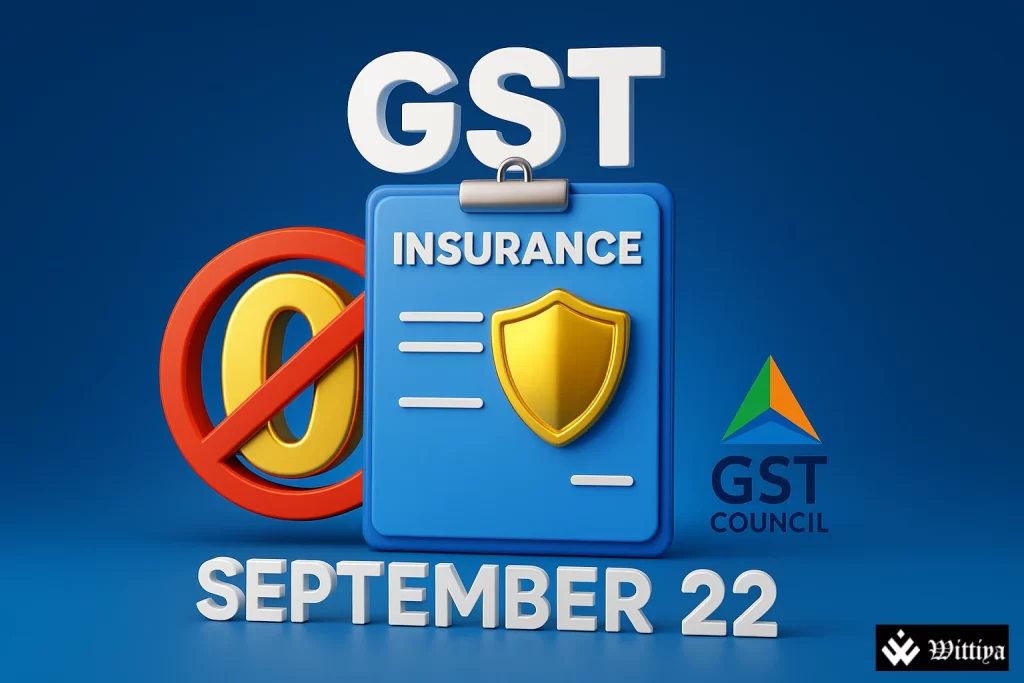
Insurers are in for a big change next year with the GST (Goods and Services Tax) on insurance brought down to zero from the previous 18% rate effective from September 22, 2025, thus providing substantial relief to policyholders. But there will be no refunds allowed on advance premiums, and the benefit will be eligible only from the subsequent renewals or new policies taken after this day.
Insurance Sector Update: GST Exemption Announced
The GST (Goods and Services Tax) Council, a decision-making body under the supervision of the Union Finance Minister, has tabulated a remarkable decision to lower insurance policy costs. With effect from September 22, 2025, the 18% GST on insurance, which has been stable over time, will be abolished for life and health insurance products.
All the individual life covers are concerned with this step, such as term insurance, ULIPs, endowment policies, as well as health insurance, e.g., family floater, and senior citizen plans. This is one of the measures taken based on the results of the 56th GST Council meeting, directed at increasing insurance penetration all over India.
No Refunds for Advance Premium Payments
One of the major concerns raised by policyholders is whether they will be given refunds for the advance premium payments made that included GST if such a decision clause were to come. The response is absolutely negative, i.e. no refunds will be entertained for the already paid GST. Taxes are obligatory at the point of payment, and the insurance coverage stays the same in the existing policies.
For example, if a six-month premium was paid for 2024, the GST part of it is already considered as accounted for and is not refundable. Only at the next renewal after September 22, 2025, will the advantage of zero GST be available.
Also Read: GST Council Meeting: Big Tax Reshuffle, EVs & Festive Push
When Will Policyholders Benefit?
The reduction in GST on insurance will be felt from the next policy renewal date after September 22, 2025.
- In this case, the policyholder with a one-year plan that ends in October 2025 will only have to pay the basic premium with no GST added.
- In the same manner, a three-year plan that will come to an end in 2027 will be able to be renewed at half the cost, that is, it will be free from the 18% charge.
This is true for the life and health insurance sectors as well, meaning that the policies will become very affordable in the long term.
GST Impact on the Insurance Market
Ever since the GST implementation in July 2017, life and health insurance premiums have been liable to additional taxes that sum up to 18% of the premium. The government earned a total of ₹16,398 crore from the insurance sector as GST in FY24, out of which ₹8,135 crore was from life insurance and ₹8,263 crore from health insurance. Besides, ₹2,045 crore went to reinsurance.
Once the exemption is implemented, policyholders will substantially save on their renewals. As life and health insurance become more affordable, this measure will likely translate into heightened demand for the products.
Other GST Council Updates
Alongside the changes initiated by the GST Council affecting insurance, other product tax brackets have also been modified. The previous rates of 12% and 28% are now reclassified into the 5% and 18% bands respectively. Nevertheless, some articles are going to be subjected to a newly established special 40% tax rate.
India is still using the four-tier GST structure (5%, 12%, 18%, and 28%), implemented in July 2017 to standardize the indirect taxes across the country.
What Policy holders Should Know
- No immediate refunds: There will be no refund of the GST already paid.
- Unchanged coverage: The rights, provisions, and specifications of the already existing policies stay the same.
Also Read: GST 2.0 Tax Changes: Cheaper & Costlier Goods List
- Start date: Only new policies and renewals (after September 22, 2025) will be Nil GST.
- Delayed consequence: Insurance-related expenses are going to decline, thus, insurance policies will become more accessible and affordable.
Key Focus: GST on Insurance
One of the most radical reforms in the history of insurance is the exemption of GST on insurance. For years, adopting policies has been primarily hindered by affordability issues. The 18% tax on premiums is a thing of the past, and insurance is no longer a luxury of the elite, but a necessity for the masses of India.
The report of the study suggests that the present scenario creates new opportunities of insurance penetration, paves the way for the government’s target of financial inclusion, and broadens the scope of family protection in both urban and rural areas.
Professional Wrap-Up
The ruling to exempt GST on insurance premiums is a breakthrough for both the insurance market and corresponding consumers. In the first place, the policyholders feel this relief directly through lowered costs. At the same time, the decision indirectly strengthens the insurance ecosystem by increasing demand and thus, driving growth. Once the policyholders’ renewal date after September 22, 2025, arrives, they will be benefiting from real savings, and it will be the very beginning of the new era of affordable insurance.
FAQ’s
From when will insurance premiums be tax free under GST 2.0?
Life and health insurance premiums will be GST-free from September 22, 2025, replacing the current 18% tax.
Will policyholders get refunds for GST already paid?
No. Refunds will not be given for advance premiums already paid with GST. The benefit applies only to renewals or new policies after Sept 22, 2025.
Which types of insurance policies are covered under GST 2.0?
The exemption applies to life insurance (term plans, ULIPs, endowment) and health insurance (family floater, senior citizen, individual plans).
How much GST revenue does the insurance sector generate?
In FY24, the government earned ₹16,398 crore in GST from insurance—₹8,135 crore from life, ₹8,263 crore from health, additional ₹2,045 crore from reinsurance.
Does GST exemption affect existing Insurance policy coverage?
No. Coverage, terms, and benefits remain unchanged. Only the tax on premiums will be removed for renewals or new policies after the effective date.
READ MORE ON