


India’s credit card delinquencies surged 44.34% to ₹33,886.5 crore as of March 2025, reflecting growing financial stress amid rising consumer spending. Analysts caution that aggressive credit usage, flat wages, and expensive borrowing costs could deepen risks in the unsecured lending space.
India’s booming credit card economy is now confronting an emerging risk: delinquencies have surged 44.34% year-on-year to ₹33,886.5 crore by March 2025, according to CRIF High Mark, a leading credit bureau recognized by the Reserve Bank of India (RBI).
The sharp rise in overdue balances within the 91–360 days category signals deepening stress in unsecured lending — an area where repayment behavior is becoming increasingly fragile amid rising consumer borrowing.
Alarming Trends in Overdue Debt
As per CRIF High Mark’s portfolio data, the 91–180 days overdue bucket alone accounted for ₹29,983.6 crore, up from ₹20,872.6 crore in March 2024 and nearly double the March 2023 levels. This segment has become particularly critical, as loans in this overdue range are often treated as non-performing assets (NPAs) under banking norms.
The Portfolio at Risk (PAR) indicator also reflects an upward trend:
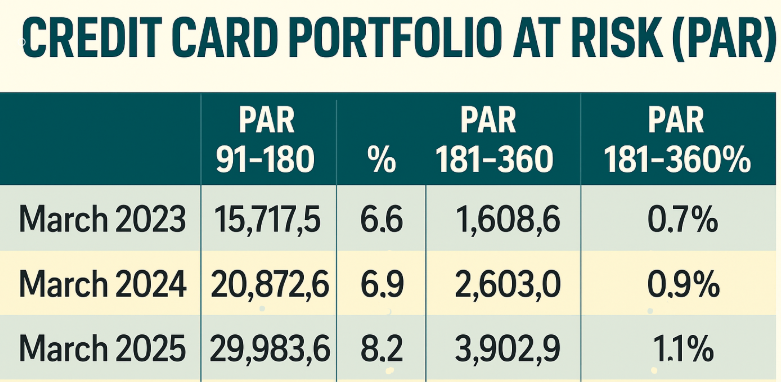
This sustained rise suggests both a growing over-reliance on unsecured credit and weakening repayment capacity.
Credit Boom, But at What Cost?
India’s credit card usage has expanded rapidly. According to RBI data:
- Credit card spending reached ₹21.09 lakh crore by FY25, up from ₹18.31 lakh crore in FY24.
- Outstanding balances touched ₹2.90 lakh crore in May 2025, rising from ₹2.67 lakh crore a year earlier.
- Active credit cards climbed to 11.11 crore in May 2025 from 10.33 crore in May 2024.
This surge in usage reflects a blend of rising economic confidence and growing dependence on credit for daily and discretionary expenses. However, when not matched by income growth or disciplined repayments, it raises systemic concerns.
Expensive Debt and Hidden Risks
India’s credit card interest rates are among the highest in the world — typically 42%–46% annually on overdue balances. While attractive incentives and lifestyle perks have driven adoption, the financial burden of unpaid dues can escalate rapidly.
“Consumers are drawn in by cashbacks and EMI offers, but missing payments even briefly can trigger compounding interest and long-term financial stress,” noted a senior banker familiar with risk modeling.
Also Read: UPI vs Credit Cards: Why Cred Is Winning the Bill Game
Broader Implications for Lenders and Borrowers
The increase in delinquencies poses systemic implications:
- For banks, rising unsecured defaults may necessitate stricter underwriting and provisioning, possibly slowing credit growth.
- For borrowers, missed payments damage credit scores, making future access to loans or credit cards more difficult.
In fact, the RBI raised the risk weights on credit card outstanding balances in 2023, signaling regulatory concern over this segment.
A Call for Financial Literacy
Experts emphasize that while credit cards offer convenience and financial flexibility, they require cautious use. Banks, fintech platforms, and regulators are now expected to double down on financial literacy initiatives that explain:
- Interest accruals post the interest-free period
- Billing cycles and payment due dates
- Minimum payment traps and credit score risks
The Indian credit card market, though growing rapidly, is also becoming more vulnerable. Unless borrowing is matched by repayment discipline, the risk of defaults may undermine the very growth it has powered.
CRIF High Mark’s data
READ MORE ON