







Sonalika Tractors has emerged as the biggest market share gainer in India’s tractor industry in the first four months of FY26. Backed by rising rural demand, strategic market focus, and robust sales momentum, the company has strengthened its position as India’s third-largest tractor manufacturer and widened its lead over competitors.
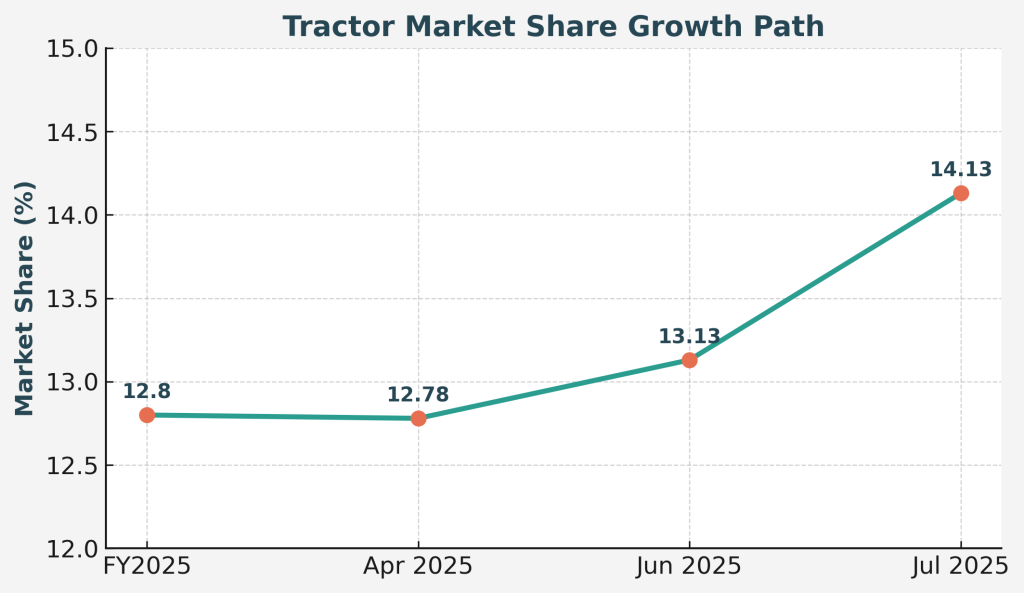
International Tractors Limited (Sonalika) has emerged as India’s fastest-growing tractor brand by market share in the first four months of FY26, according to recent data from the Federation of Automobile Dealers Associations (FADA). As of July 2025, the company has captured 14.13% of the domestic market, securing its position as the third-largest tractor OEM in India.
Tractor Industry Rebounds with 7.67% Growth in Early FY26
After a modest contraction of 1.04% in FY25, India’s tractor industry has rebounded, registering a 7.67% year-to-date growth between April and July 2025, with total sales reaching 2,98,978 units. Sonalika has outperformed this sectoral average by a wide margin.
In FY25, the company held a 12.80% market share with sales of 1,14,207 units. By July 2025, monthly sales climbed from 7,782 units in April to 12,536 units, resulting in a 14.13% market share. This reflects a 12.4% year-on-year growth in July alone — the highest among all competitors.

Strategic Rural Focus Drives Performance
Sonalika’s strategic alignment with India’s rural economic revival has been instrumental in its recent success. The company has deeply penetrated high-potential rural markets, particularly in the 35–75 HP segment, where demand remains resilient among medium to progressive farmers.
FADA data reveals that rural tractor sales grew 8.70% in FY25, vastly outpacing the 0.28% growth in urban regions. Sonalika’s expansive rural dealership network, tailored product offerings, and after-sales service enhancements have enabled it to capitalize on this disparity effectively.
Also Read: India’s Auto Retail Contracts 4.31% in July as Rural Demand Slows
Favorable Financing and Policy Support Bolster Sales
The company’s strong FY26 start coincides with improving macroeconomic indicators for the rural economy. A 25-basis-point cut in the repo rate in June 2025 has started to ease borrowing costs for agri-equipment buyers. Simultaneously, a 3% hike in Minimum Support Prices (MSPs) for kharif crops announced in May has enhanced liquidity among farming households.
These factors have collectively strengthened the affordability and accessibility of tractors, particularly for price-sensitive rural buyers.
Competitive Landscape: Sonalika Widens Lead Over Rivals
While the market continues to be led by larger OEMs with a combined 42% share, Sonalika’s growth trajectory stands out. The company has widened its lead over the fourth-largest manufacturer, increasing the gap from 0.7 percentage points in FY24 to 4.1 percentage points as of July 2025.
Industry observers suggest this momentum reflects not only short-term cyclical tailwinds but also long-term operational execution. Sonalika’s ability to consistently align with rural dynamics and product demand cycles has positioned it as a scalable, resilient player in the sector.
Export Leadership Strengthens Global Position
Beyond domestic dominance, Sonalika continues to lead India’s tractor export market with a 34% share. As India’s largest tractor exporter by volume, approximately one in every three tractors shipped from the country carries the Sonalika brand. This global scale strengthens its economies of scale, brand equity, and competitiveness.
Outlook: Strong FY26 Momentum Supports Further Consolidation
Looking ahead, Sonalika’s strong performance in the initial months of FY26 signals continued upward momentum, barring significant external shocks. With favorable monsoon patterns, improved credit access, and supportive government policies, the agricultural machinery segment is expected to remain buoyant.
If these trends persist, Sonalika is likely to further consolidate its position in the domestic market and extend its lead in exports — reinforcing its role as a pivotal force in India’s rural mechanization journey.
READ MORE ON