






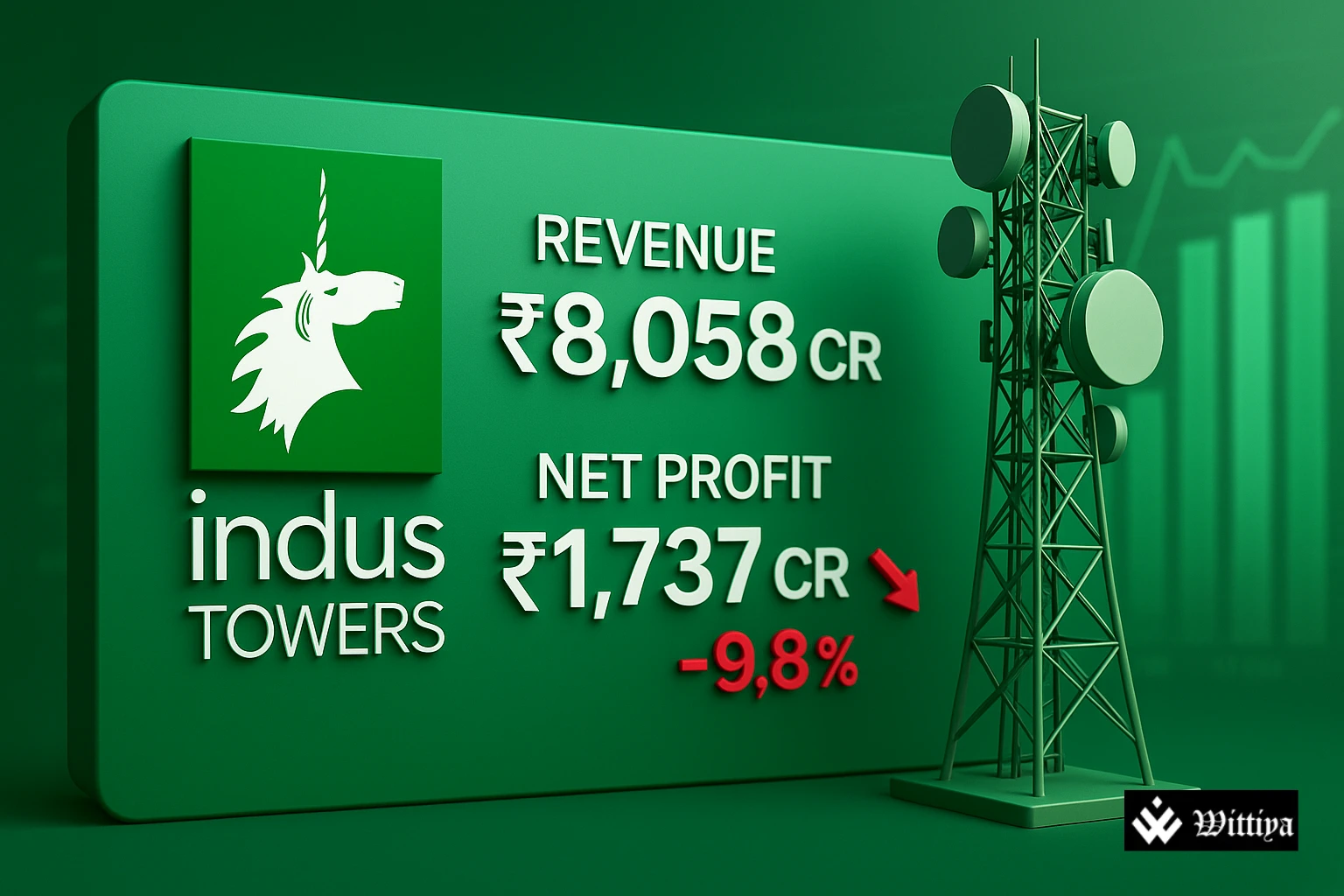
Indus Towers Ltd reported a 9.8% year-on-year decline in net profit for Q1 FY26 despite an increase in revenue, as rising operational costs eroded profitability. The company also cautioned about potential risks from its continued exposure to Vodafone Idea despite resumed payments.
Indus Towers Ltd, headquartered in Gurugram, Haryana, is a leading player in India’s telecommunications infrastructure sector. The company primarily offers passive infrastructure services such as tower construction, maintenance, and co-location to telecom operators across the country. Indus Towers is a subsidiary of Bharti Airtel, one of India’s largest telecom service providers.
For the quarter ended June 2025, Indus Towers posted a net profit of ₹1,737 crore, marking a 9.8% decline from the same period last year. This drop occurred despite a 9.1% increase in revenue to ₹8,058 crore, reflecting the company’s growing scale but also its vulnerability to cost pressures.
Also Read: Why Did 50+ Indian Companies Choose July 18 for Big Payouts?
Total expenses surged by 29.2% year-on-year, reaching ₹3,667.5 crore. Among these, power and fuel expenses rose to ₹3,068.7 crore, up 5.8%, while employee benefit costs increased by 8.2% and maintenance expenses by 2.9%. These rising overheads significantly compressed operating margins for the quarter.
Despite resumption of payments from Vodafone Idea, Indus Towers wrote back ₹88 crore in provisions against overdue receivables. As a result, its doubtful debt provision decreased to ₹209.9 crore from ₹298.1 crore in the previous quarter. However, the company acknowledged the continued business risk associated with the financially stressed telecom operator, warning that any disruption in business from Vodafone Idea could materially impact future financials.
Also Read: The Rise and Fall of Vodafone Idea: A Telecom Giant’s Struggle Unfolds
During the reporting period, Indus expanded its network by adding 2,468 macro towers, taking the total to 251,773 tower sites. Co-locations increased by 5,777, reaching a total of 411,212. Net finance costs also saw a modest 2.9% year-on-year decline to ₹396.5 crore, offering some relief amidst operational headwinds.
The company reiterated its focus on innovation and scalability. It is investing in emerging technologies, including artificial intelligence and digital infrastructure, to enhance long-term operational efficiency and competitiveness in a dynamic industry.
READ MORE ON