


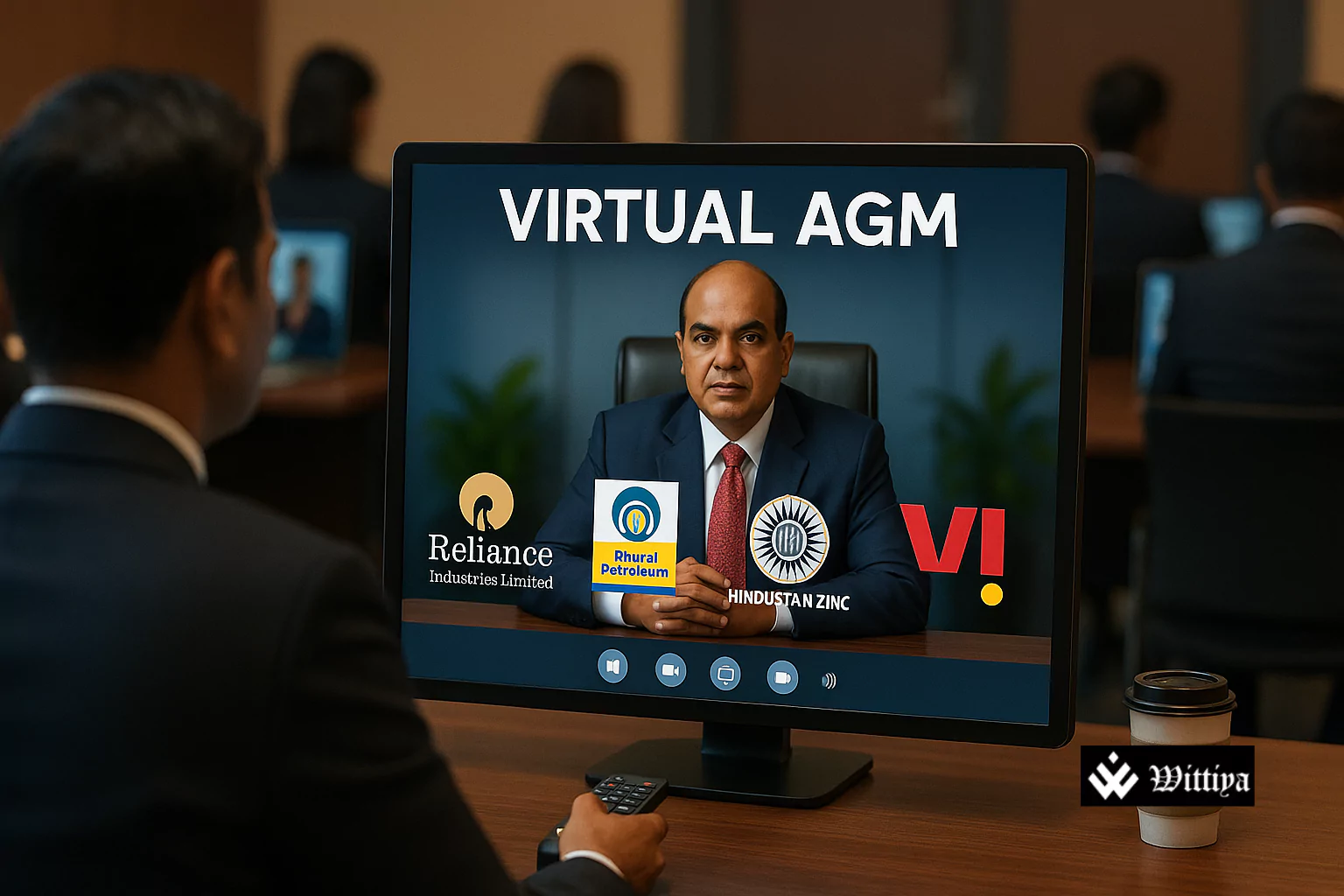
Indian corporations are going more and more for virtual Annual General meetings (AGMs) which allow them to save time, and money besides offering them convenience. Such giants as Reliance Industries, BPCL, and Hindustan Zinc are the trend-setters of going digital to hold their AGMs. However, experts are still recommending extensive safety measures to guarantee that the shareholders rights as well as transparency are respected.
The virtual formats for annual general meetings (AGMs) are being embraced more and more by India’s corporate sector as these are fundamentally changing the modalities through which shareholders keep in touch with company management. The 48th AGM of Reliance Industries, normally a face-to-face affair with the Ambani family and its shareholders, will be held fully online on August 29. However, in a manner almost mirroring the absence of physical gatherings, updates on major initiatives, including timelines for Reliance Jio and Reliance Retail IPOs and progress in the company’s new energy business, will be given to investors.
Moreover, on the same day, BPCL, Hindustan Zinc, Vodafone Idea, and other giant firms will conduct their AGMs through video conferencing. The MCA allowed companies to comply with social distancing through online meetings, which led to the widespread practice of virtual AGMs in 2020 during the Covid-19 pandemic. The provisions have been extended later, with some firms adopting hybrid formats that combine physical and digital attendance.
Also Read: Indian Oil and BPCL Resume Russian Crude Purchases at $3 Discounts
Virtual AGMs do have their pros and cons. For example, virtual AGM advantages are broader shareholder participation, cost savings, and simplified logistics. However, they may also threaten the shareholders rights. One of the most important advantages of a physical meeting is that it allows the shareholders to feel the management’s body language, work together on their concerns, and ask executive questions directly. Experts warn that the virtual format might lead to less transparency as corporations might mute dissent and screen only those questions they find easy to answer. This highlights the need for mechanisms that secure the rights of minority shareholders.
In corporate terms, the virtual format of AGMs decreases the chances of disruption by minority shareholders with minimal holdings while at the same time, it allows those concerned about the topic of your concern to talk to you via other channels. The biggest challenge is to balance efficiency (which is the greatest benefit of virtual AGMs), digital access (the democratization of which is the real purpose), and corporate accountability (which should always be the ultimate goal) as India is fast-forwarding its digitization of corporate governance.
READ MORE ON