


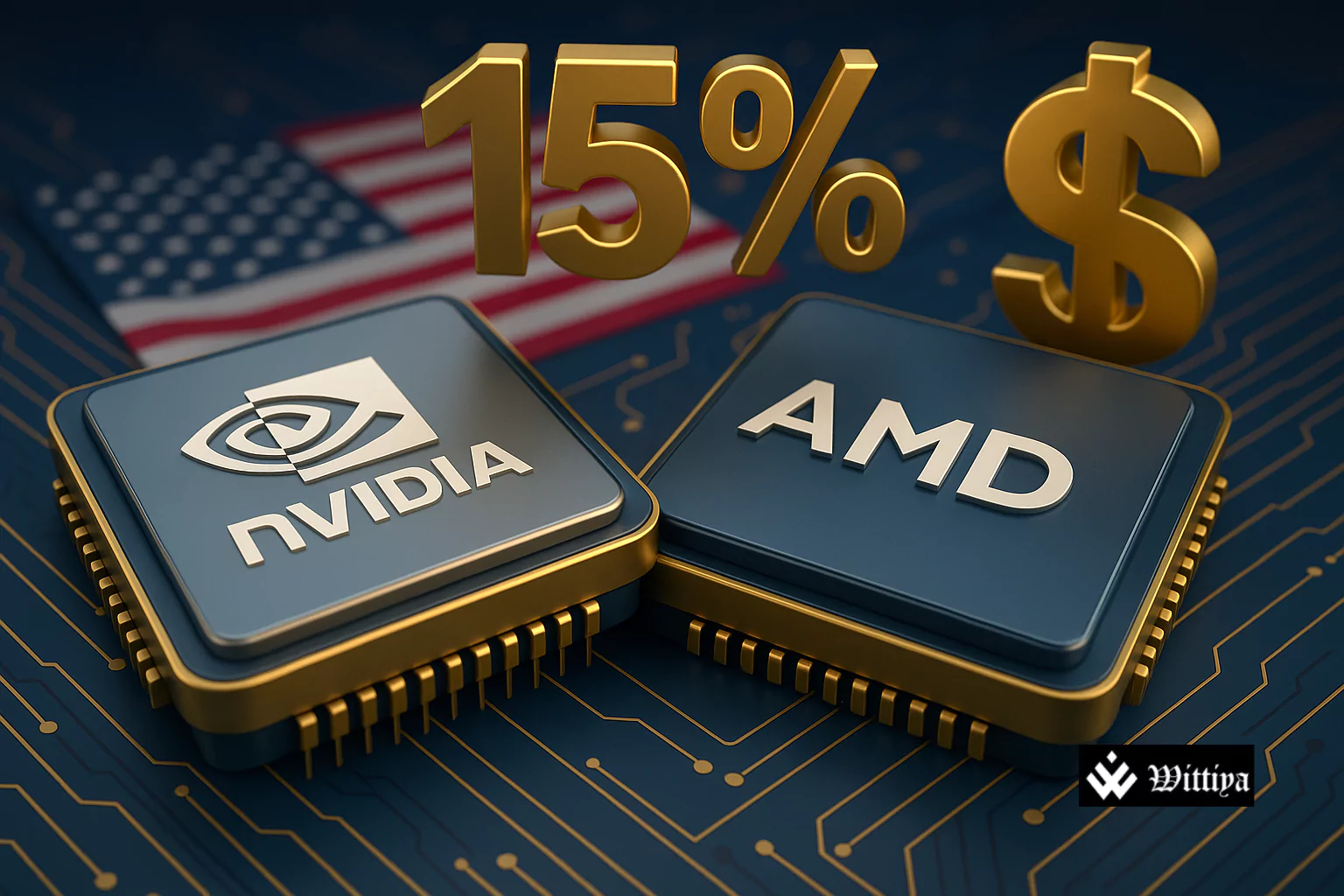
Nvidia and AMD have agreed to remit 15% of their chip sales revenues in China to the U.S. government in exchange for export licenses, marking a significant development amid ongoing trade tensions.
In a landmark move amid ongoing trade tensions between the United States and China, Nvidia Corporation (Nvidia) and Advanced Micro Devices, Inc. (AMD) have agreed to allocate 15% of their revenue from specific chip sales in China to the U.S. government. This arrangement grants both companies export licenses to sell Nvidia’s H20 and AMD’s MI308 chip models in the Chinese market, according to reports.
This agreement reflects an unprecedented collaboration between the semiconductor giants and the U.S. administration, signaling a strategic balance between commercial interests and regulatory compliance. The U.S. government’s approach appears to leverage revenue-sharing as a bargaining tool to maintain market influence amid the escalating tariff policies initiated by President Donald Trump.
Nvidia’s CEO, Jensen Huang, recently held discussions with President Trump, underscoring the importance of securing market access under evolving trade restrictions.
We follow rules the U.S. government sets for our participation in worldwide markets.”
Nvidia
The move follows President Trump’s declaration to impose a 100% tariff on semiconductor imports unless manufacturing occurs within the United States, a policy expected to reshape global supply chains significantly. The revenue-sharing model offers a pathway for Nvidia and AMD to continue sales in China, albeit under stringent conditions.
Also Read: India’s Semiconductor Dream Becomes a Global Reality
Financial analysts suggest that while the arrangement mitigates immediate export challenges, it may also set a precedent for future agreements between multinational corporations and government entities amid trade disputes. The arrangement’s impact on pricing, profit margins, and chip availability in China will be closely monitored by industry stakeholders.
This development highlights the intricate interplay between global semiconductor supply chains, geopolitical strategy, and corporate governance, particularly as the U.S. government intensifies efforts to bolster domestic manufacturing and control technology exports.
READ MORE ON