


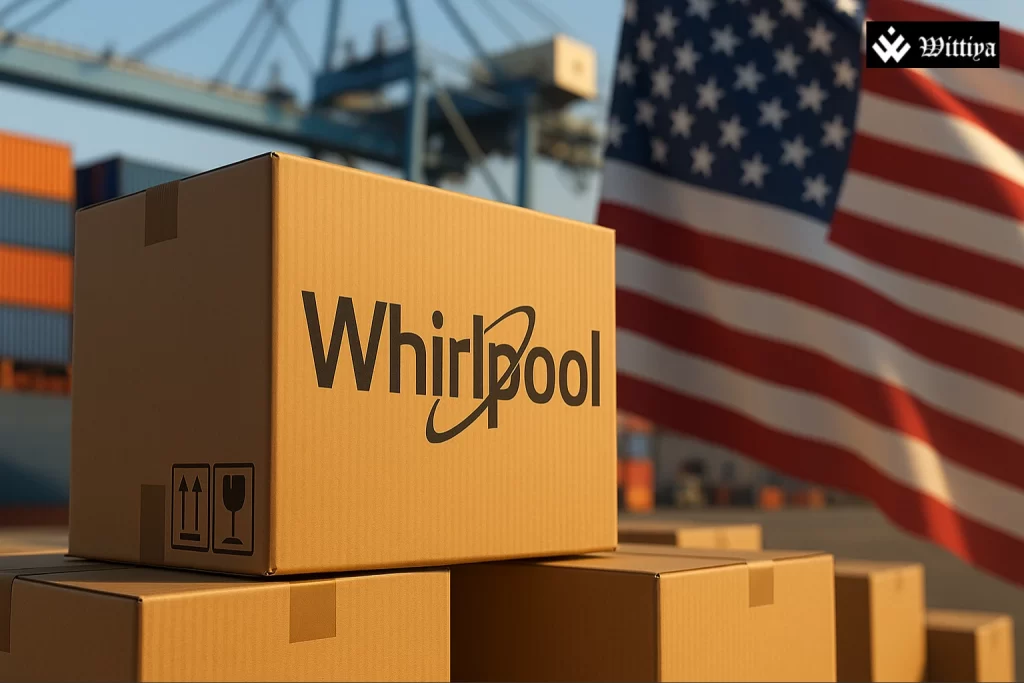
Whirlpool, an American appliance giant, is being pressured more and more by competitors who are likely to use the tactic of stockpiling imports to avoid tariffs. The move has led to increased competition, lesser profits, and a query as to how U.S. manufacturers can deal with the uncertainty of trade policy.
Whirlpool Stockpiling Hits Hard
A new dynamic has been created in the United States appliance industry that the competitors are racing to stockpile goods ahead of the tariffs. At the epicenter of this tempest is Whirlpool, a company that has always been regarded as a fundamental part of American production but now is dealing with the decrease in profits as its competitors take advantage of the loopholes in the trade policies to gain more profits.
Whirlpool Stockpiling: A Competitive Blow
In the report of its second quarter, Whirlpool let the stockpiling strategy kill the company by showing how this has become very destructive. In order to be able to supply the market with the goods before tariffs are introduced, competitors overstocked shipments of Asian goods to the US, thus the appliances were in excess. This operation not only disrupted market supply but also diminished Whirlpool’s ability to set prices and compelling the company to face the lower-priced goods which had flooded into the market.
The Chief Executive Officer Marc Bitzer said the effects were what they had anticipated but expressed confidence in the long-term advantages of tariffs.
We take the view that these trade actions will in the end be supportive of domestic manufacturing,” he said.
Marc Bitzer, CEO of Whirlpool
However, currently, Whirlpool bears the burden of the activities of the rivals who stockpile in an aggressive manner.
Weak Earnings Emphasize Tariff Pressure
The financial results of Whirlpool depicted a challenging scene. Adjusted profit was halved to $1.34 a share, down from $2.39 a share in the same quarter of the previous year. According to the survey conducted by FactSet, the analysts predicted that the firm would do better with a profit of $1.68 a share, thus there was a large discrepancy between the predictions and the actual results.
The sales volume also fell short of the target, sliding 5% to $3.77 billion compared to the average forecast of $3.85 billion. The weak results show how the market distortions caused by tariffs, combined with the precariousness of consumer demand, are putting pressure on Whirlpool’s organization.
Also Read: Whirlpool Shines Bright with 50% Profit Surge and Dividend Boost
Dividend Cut Highlights Financial Strain
One significant move was perhaps Whirlpool's cutting its dividend in half. The shareholders are expected to get 90 cents per share, which is down a lot from the first and second quarters when it was $1.75. The decision is indicative of a company that is keen on using and saving cash in the current atmosphere of uncertainty and also re-establishing its balance sheet with confidence.
Just at a time like this, we choose to concentrate on actions under our control—cutting off unnecessary costs, taking care of debt that is going to come due, and making sure that we will be able to go through this difficult period without any financial problems.”
Jim Peters, CFO of Whirlpool
Guidance Reflects Uneasy Stability
For the year 2025, Whirlpool was rather conservative in its expectations – sales were expected to remain the same at $15.8 billion as in April, and adjusted earnings per share were projected to be between $6 and $8. The range signifies the caution exercised by the management, marking a clear difference from the forecast in April of about $10 a share.
The prediction of sales of $15.6 billion and EPS of $8.96 by the Analysts are the numbers that both characterize the difficulties that whirling faces as well as the broader doubt in the U.S. trade and consumer sectors.
Trade Policy Uncertainty
The trade background is still uncertain. The Trump administration has hinted at new possible trade agreements following its deal with the EU, while the talks with China are still going on. Every change in policy for Whirlpool can mean either a step forward or more trouble as tariffs influence both the behavior of competitors and the prices consumers pay.
Moreover, the rival’s stockpiling is a strategy for a short time, but the consequences of it are long-lasting. It reveals the vulnerabilities of U.S. manufacturers when global supply chains and trade timelines can be altered to gain market share. The experience of Whirlpool is an example that shows how tightly policy and market realities are linked.
Investor Impact
The stock price of Whirlpool has fallen by more than 14% this year, while the S&P 500 has risen by 9% during the same period, thus the performance of the former is clearly inferior to that of the latter. The drop is made up of worries among investors which include the volatility of earnings, competitive headwinds, and the risk of tariff uncertainty extending over a long period.
However, management is not giving up. Bitzer and Peters convey that Whirlpool’s concentration on cost efficiency, local production, and balance sheet robustness will enable it to survive the coming troubled times. Whether investors concur with that is dependent upon the outcome of trade talks and if the rival’s stockpiling advantage is coming to an end or not.
FAQ’s
What is stockpiling?
Stockpiling in business is when companies accumulate large inventories of goods ahead of time, usually to be ready for any disruptions such as tariffs, shortages, or supply chain delays.
How stockpiling impacts consumers?
By stockpiling, the prices can be lowered temporarily due to the oversupply, but over time, there may be less competition and higher costs if the situation with tariffs or shortages continues.
Does Whirlpool own other brands?
Yes, besides the several appliance brands such as KitchenAid, Maytag, JennAir, and Amana that are already popular, Whirlpool is the owner of these.
Is the Whirlpool Company on the Fortune 500 list?
Yes, Whirlpool Corporation is regularly ranked among the top 500 American companies by revenue on the Fortune 500 list.
READ MORE ON