


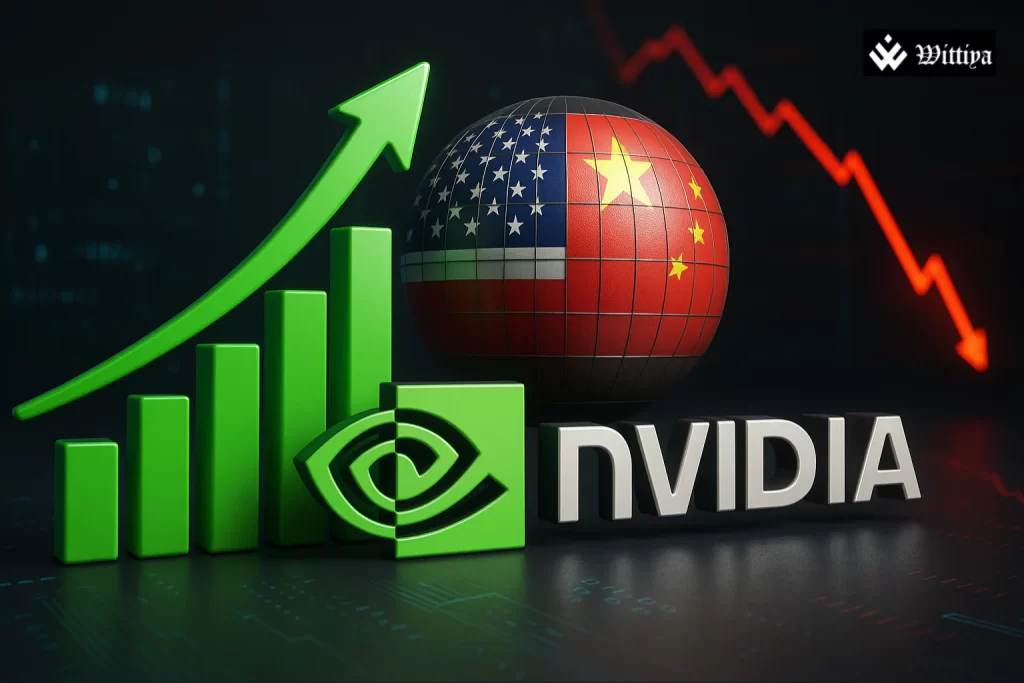
Nvidia, a US-based company, announced that its turnover for the second quarter of 2025 was $46.7 billion, which is an increase of 56% year-on-year, mainly due to the strong demand for AI infrastructure. Although the US-China trade restrictions have had an impact on chip exports, Nvidia keeps being the leading force in the AI chip market, as the sales of data centers have made the company win $41.1 billion. The company plans $54 billion of revenue for the following quarter, thus confirming its market leadership while dealing with geopolitical challenges and the intensified competition from Chinese domestic chipmakers.
Nvidia AI Boom Revenues Surged Significantly in Spite of US-China Tensions Once again, Nvidia of the United States has shown the power of the continuous AI explosion by reporting $46.7 billion for the second quarter of 2025, which is a 56% increase from the corresponding period of the previous year. The upsurge signals not only the ever-increasing need for AI infrastructure but also the company’s ability to endure despite all the geopolitical tensions between the US and China.
Nvidia’s semiconductors are still fundamentally the core of global artificial intelligence progress, consisting of the hardware installed in data centers, cloud networks, and AI models. Though the shares slightly fell after the trading period had ended, the firm declared that their status as a market leader in the AI chip sector was unaffected.
Data Center Scale and Domination of the Market
Within the half-year, the income from centers where resources for AI services are used has raised more than $41.1 billion from 27.6 $ billion, thus showing that the company has made a solid step towards the provision of AI solutions. Assumptions about the higher demand by many very large corporations for digital and cloud technologies are being confirmed by Nvidia; the company asserts that the big four’s investments have doubled to almost $600 billion per year.
Nvidia’s CEO, Jensen Huang, spoke about the contributions of AI to productivity and GDP growth being even greater in the future, and added “The large part of the AI infrastructure is what we are bringing in.”
Even though the data center arm narrowly missed analyst expectations, it remains the main source of promise for Nvidia and is indicative of the enterprise’s extensive adoption of AI solutions.
Also Read: Nvidia Earnings Put Wall Street’s AI Optimism to the Test
Financial and Strategic dimensions
From an economic point of view, the path of Nvidia reflects a mixture of courage and risk. Revenue forecast for the coming quarter is $54 billion, which is more than the street tends to expect, but the company has by no means taken potential H20 chip sales in China into account in its outlook.
Nvidia was the first $4 trillion company in the world in July 2025 — a landmark that reflects not only investor positivity but also the contribution of AI chips in the next wave of technology revolution. However, analysts caution against overheating of valuation, predicting bubble-like scenarios.
Geopolitical Headwinds: US-China Tensions
Although Nvidia is still operating under such constraints, the company is pointing out that the trade restrictions especially affect the performance of the AI chips sector. The US government reviewed licenses for Nvidia’s H20 chips to China; however, there has not been any shipment so far this year.
The Trump administration’s policy changes, which target the use of AI technology by the Chinese military, have compelled Nvidia to adjust its strategy as well as lobby for permission to release new lines of products similar to Blackwell series. China is still the leading consumer of AI microchips, but it is also developing domestic chip production alternatives, thus posing a long-term challenge to Nvidia’s supremacy.
Analyst Commentary on Nvidia AI Boom
Market experts depict Nvidia as “without rivals” in the AI chip sector but state that the company depends on the large-scale technology firms that are the main source of its revenues. While this support makes the company more profitable in the short term, it also makes it more vulnerable to the fluctuations of the enterprise.
In parallel, the company’s robotics and AI activities outside their core focus may open other opportunities of growth which can further consolidate the position of Nvidia as the bellwether of the worldwide AI ecosystem.
Q1: How much revenue did Nvidia report this quarter?
Nvidias revenue for the second quarter of 2025 was $46.7 billion, representing a year-on-year growth of 56%.
Q2: What is the role of Nvidia in the AI boom?
The GPUs of Nvidia are the most essential part of the AI, thus the whole AI industry relies on them. That’s why Nvidia data centers are being used to host generative AI platforms, which, in turn, are employed by leading AI companies all over the world.
Q3: How are US-China tensions impacting Nvidia?
Export controls on the high-end AI chips have resulted in a greater supply of the products in the Chinese market. Consequently, the company is trying to get the necessary permits to satisfy demand, while the Chinese government is supporting the local companies by investing in them.
READ MORE ON