






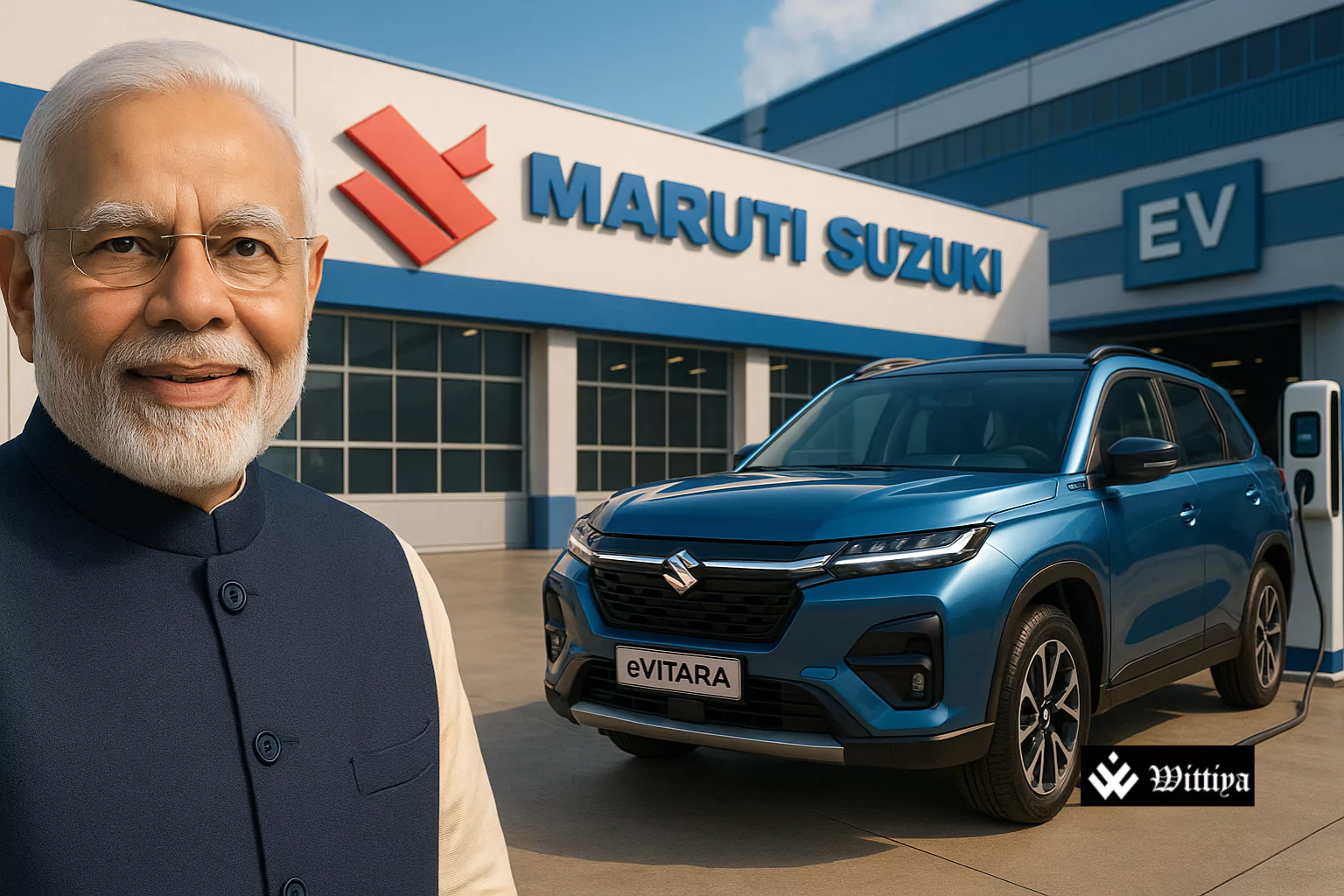
Within no time, India will be celebrating a significant milestone marked by the event of the Maruti Suzuki EV and battery plants inauguration by the Indian PM Narendra Modi. This plant will be the home of the production of the awaited eVitara SUV and lithium-ion batteries, making it a huge step towards the Electric Vehicle exports from India.
India is proceeding with a major step in its electric vehicle manufacturing journey with Maruti Suzuki’s new curtain-raiser scheduled in Gujarat to showcase their upcoming electric car alongside a lithium-ion battery factory. The new facility will bring Maruti Suzuki’s production of their eagerly anticipated eVitara electric SUV to India.
Not only will the eVitara, which was initially presented at Bharat Mobility Global 2025, be made in India for domestic use, but it will also be exported to 100 countries. Production of lithium-ion batteries will take place at the new plant in Gujarat to power the eVitara and other hybrid vehicles, thus creating a local supply chain for the battery in India and reducing import reliance.
In simple terms, investing in the electric vehicle and battery sectors shows Maruti Suzuki’s strategic decision to cater to the global demand and at the same time to India’s overall industrial policy which aims at export promotion and trade balance improvement. According to analysts, through massive exports of electric vehicles, India can transform herself into a cost-competitive hub for clean vehicle technologies of the future.
Also Read: IndusInd Bank and Maruti Suzuki Take the Spotlight on Nifty 50
The two battery pack variations for eVitara would be 49 kWh and 61 kWh which would be capable of delivering ranges varying from 346 km to 428 km depending on the configuration. Moreover, with features like advanced driver assistance systems (ADAS), a 10.25-inch instrument cluster, ventilated seats, and a 360-degree camera, this model aims to carve out a place for itself in the premium EV segment.
Industry experts claim that the Indian electric vehicle market, which is already present but has a long way to go, is gearing up due to the decision of the manufacturers to inculcate local production and set up separate battery facilities. The Gujarat plant places India not just in a stronger position in terms of her manufacturing capabilities but also in line with the global trend, where companies are choosing to vertically integrate their operations to reduce costs as well as secure batteries.
The event organized by Prime Minister Modi is a landmark project, both in terms of symbolism and strategy, embodying India as one of the new manufacturers of electric vehicles and thus being able to supply the global markets as well as the domestic demand.
READ MORE ON