





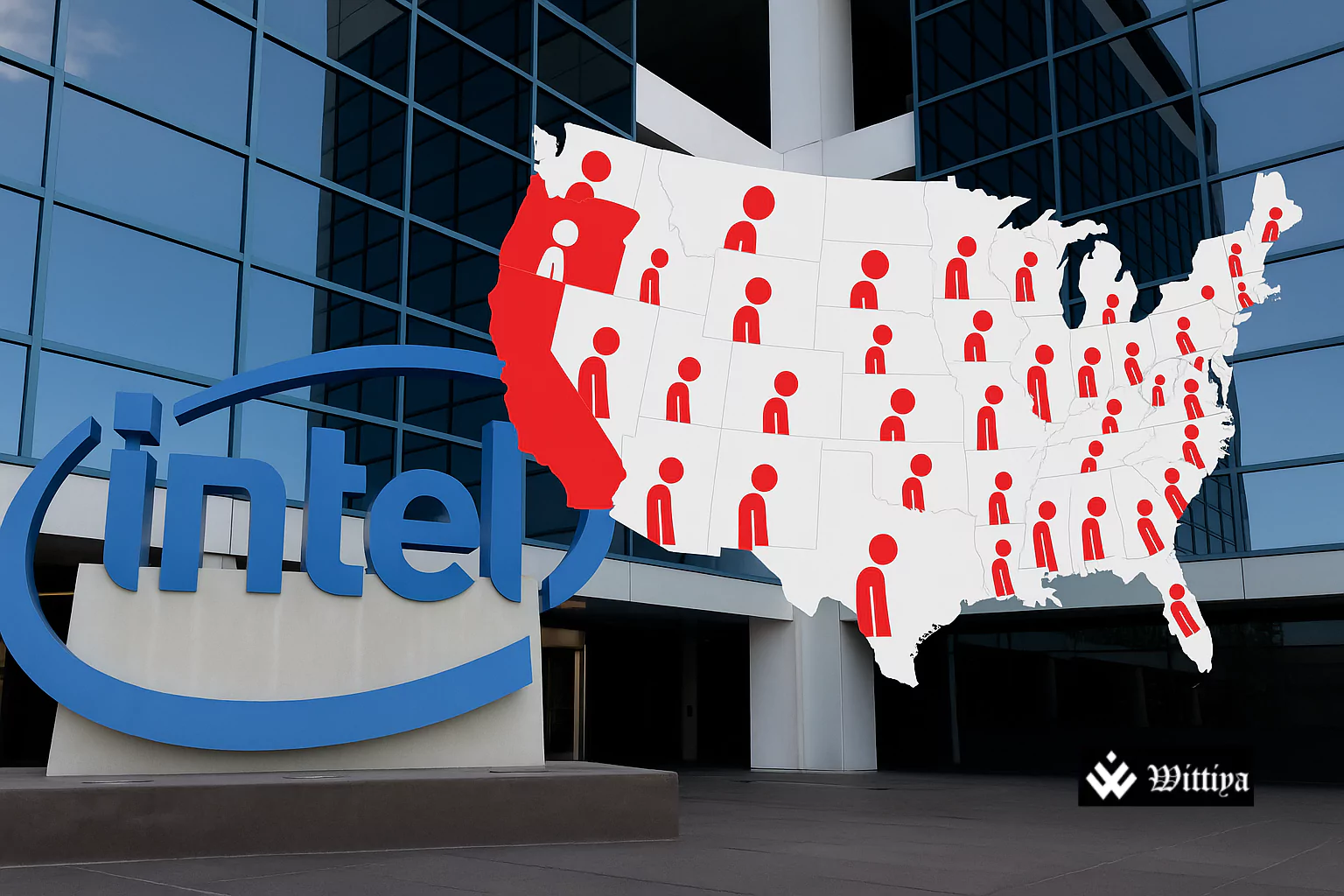
Intel is set to lay off more than 5,500 employees across the United States, with California and Oregon bearing the largest impact. The decision reflects the company’s ongoing struggle in the global semiconductor and AI chip markets, and a bid to regain competitiveness under new leadership.
Semiconductor giant Intel has confirmed plans to lay off more than 5,500 employees across various U.S. states, with California and Oregon expected to see the most significant workforce reductions. This strategic move is part of Intel’s ongoing cost-cutting and restructuring efforts amid a declining market position in the global chip industry.
According to filings made under the Worker Adjustment and Retraining Notification (WARN) Act, Intel’s revised layoff estimates have escalated sharply. In California alone, the company will cut 1,935 jobs—double its earlier projection. Oregon, where Intel has its largest manufacturing footprint, will see 2,932 jobs slashed, four times higher than initial estimates. Arizona will also be affected, with 696 employees set to lose their jobs.
The layoffs come as Intel grapples with intensifying competition in both the central processing unit (CPU) and artificial intelligence graphics processing unit (AI GPU) segments. The company has fallen behind key rivals and lost significant market share, with CEO Lip-Bu Tan acknowledging that Intel is no longer among the top 10 global semiconductor players.
“The world has changed. We were the leader 20 to 30 years ago. Now, we are not even in the top 10,” said Tan during a recent internal meeting. He highlighted performance issues, including slower innovation, customer dissatisfaction, and weaker AI chip capabilities compared to competitors.
Intel’s broader plan reportedly includes a 20% reduction in global workforce as part of a multi-year turnaround aimed at becoming leaner, more innovative, and better aligned with the performance standards of modern chipmakers. The company also aims to position its upcoming manufacturing node, Intel 18A, as a viable alternative to leading technologies.
However, internal concerns suggest adoption of Intel 18A could be slower than expected. The company’s strategic pivot to offer foundry services is also facing headwinds, and leadership remains cautious about competing in segments already dominated by established players.
Intel’s current market capitalization stands at approximately $103 billion—less than half its value 18 months ago. This stark contrast reflects the broader challenge Intel faces in regaining investor confidence and market relevance in an era increasingly driven by AI demand and chip performance.
As Intel moves through this significant transition, focus remains on cost optimization, renewed innovation, and recovery in both consumer and enterprise segments. The upcoming months will be critical in determining how effectively the company can reposition itself within the rapidly evolving semiconductor landscape.