





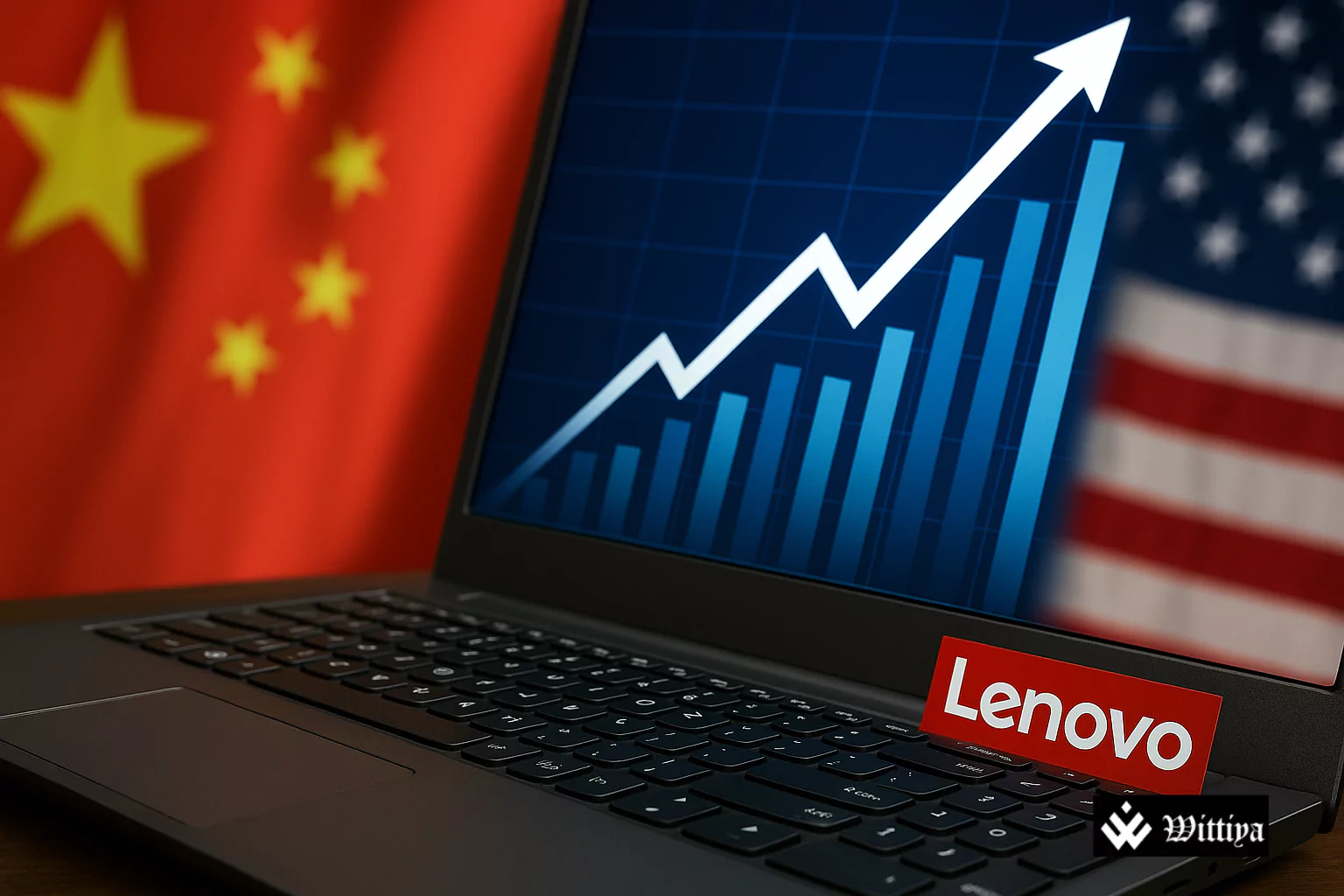
China’s Lenovo posted strong Q1 results with revenue up 22% to $18.8 billion and net profit doubling to $505 million, as robust AI demand offset U.S.-China tariff tensions. The 90-day tariff pause brings temporary relief, while AI PCs and servers fueled major growth.
China’s Lenovo, the world’s largest PC maker, reported a strong start to the fiscal year with first-quarter results that exceeded market expectations despite persistent U.S.-China trade tensions. Revenue for the quarter ended June 30, 2025, rose 22% year-on-year to $18.8 billion, well above forecasts of $17.4 billion, while net profit more than doubled to $505 million, significantly higher than the consensus estimate of $307.7 million.
The results came as Washington and Beijing agreed to extend a 90-day pause on tariffs until November, providing businesses on both sides with temporary relief. Lenovo’s Chief Executive Yang Yuanqing described the truce as a welcome development, noting that it offered greater stability. “The truce is a positive situation. It brings us more certainty rather than uncertainty,” he said following the earnings release.
The growth was driven largely by surging demand for artificial intelligence products. AI-enabled PCs represented more than 30% of all Lenovo shipments in the quarter, while its AI server business expanded by 150% year-on-year, supported by strong local demand and continued investment in China’s fast-growing AI infrastructure. Yang emphasized that Lenovo sees a strong pipeline for AI servers, reinforcing the company’s strategy to capture a bigger share of the digital infrastructure market.
Also Read: Lenovo Crashes! Earnings Collapse as Rivals Close In
While Chinese exports to the U.S., including PCs, face a 30% levy, Lenovo has been shielded from significant impact thanks to its diversified global manufacturing footprint. The U.S. contributed less than 20% of the company’s overall revenue, underscoring its limited exposure to tariff risks. At the same time, Lenovo has been investing in local component production to strengthen supply chain resilience, ensuring it can meet domestic requirements while continuing to partner globally.
Despite the robust performance, Lenovo’s shares slipped more than 3% in early trading, in contrast to a 0.4% rise in the Hang Seng Index. However, the stock remains up around 15% over the past three months, outpacing the benchmark and reflecting investor confidence in its AI-led strategy.
Financial experts point out that Lenovo’s results highlight the increasing importance of AI in driving profitability for technology companies, even amid volatile trade conditions. With a growing base of AI PC and server sales, coupled with policy stability from the tariff pause, Lenovo has positioned itself strongly for the remainder of the fiscal year, though its outlook will continue to depend on global trade dynamics and semiconductor supply conditions.
READ MORE ON