


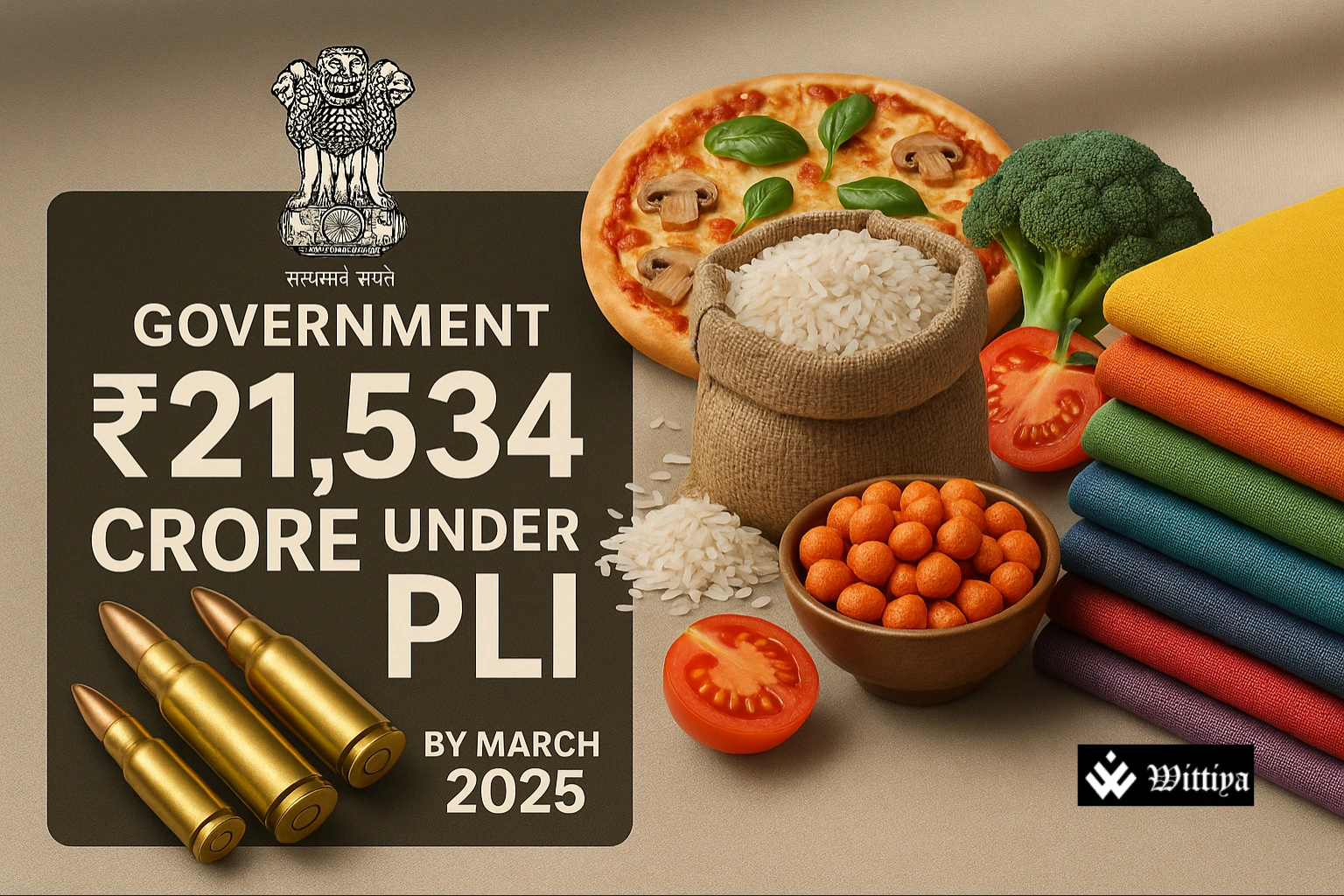
India’s Production-Linked Incentive (PLI) schemes have led to incentives worth ₹21,534 crore across 12 sectors, attracting ₹1.76 lakh crore in investments and generating ₹16.5 lakh crore in production. The scheme has notably boosted exports in pharmaceuticals, food processing, and textiles.
India’s Ministry of Commerce and Industry, under the leadership of Union Commerce Minister Piyush Goyal, announced that the Production-Linked Incentive (PLI) schemes have resulted in a total incentive disbursal of ₹21,534 crore as of March 2025. These incentives, spanning 12 critical sectors, have attracted investments worth ₹1.76 lakh crore and resulted in cumulative production and sales of ₹16.5 lakh crore.
The announcement followed a comprehensive review meeting chaired by the Minister in New Delhi. During the meeting, the Minister emphasized the need to focus on sectors where India holds a strategic advantage.
“India must prioritise the sectors in which it has a competitive edge over other countries,” said Goyal.
The PLI scheme, which is aimed at boosting domestic manufacturing and reducing import dependency, has been implemented across sectors such as large-scale electronics manufacturing (LSEM), IT hardware, pharmaceuticals, food processing, white goods, telecom products, drones, specialty steel, textiles, and automobiles.
Also Read: Why Can’t India Shake Off China’s Manufacturing Grip?
One of the standout success stories is the pharmaceutical sector, which achieved cumulative sales of ₹2.66 lakh crore over three years. Exports accounted for ₹1.70 lakh crore, and in FY 2024–25 alone, pharma exports under PLI were ₹0.67 lakh crore—representing 27% of India’s total pharma exports that year.
The sector also saw ₹37,306 crore in investments, with 40% dedicated to research and development (R&D). The domestic value addition in pharma stood at an impressive 83.70% by March 2025. India has now transitioned from a net importer to a net exporter of bulk drugs, with a swing from ₹-1,930 crore in FY 2021–22 to ₹2,280 crore in FY 2024–25.
The food processing sector has also benefited significantly, attracting ₹9,032 crore in investments and generating ₹3.8 lakh crore in production. It has also created direct and indirect employment for approximately 3.4 lakh individuals.
The Ministry added that similar gains are evident in the textile and bulk drug sectors, which are helping reduce India’s dependency on imports and boost global competitiveness.
The government continues to back its PLI initiatives as a key pillar in the vision of ‘Aatmanirbhar Bharat’, aiming to transform India into a global manufacturing hub.