


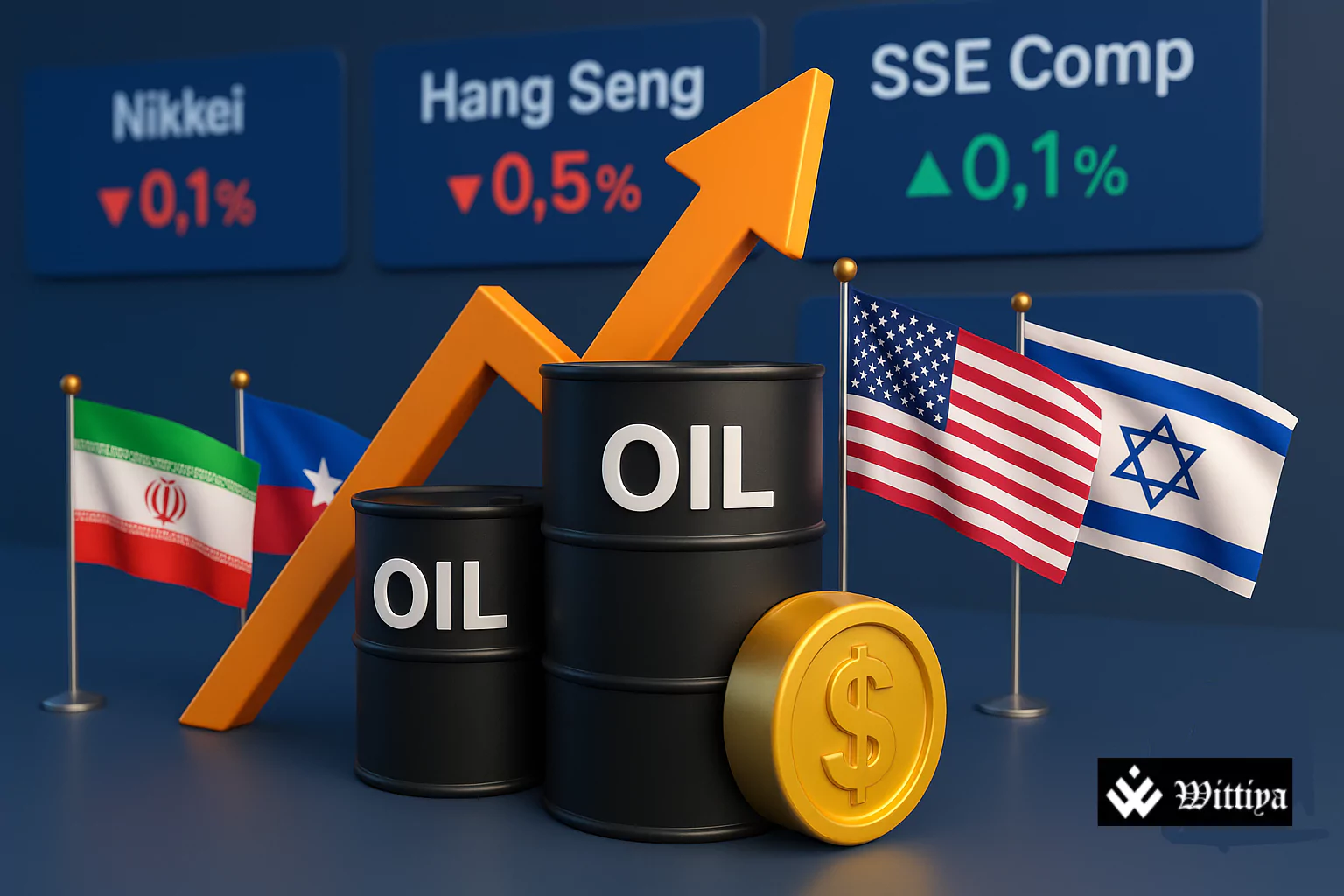
On June 20, 2025, markets across Asia showed mixed performance while oil prices climbed amid growing geopolitical uncertainty. Investors await clarity on whether the U.S. will join Israel’s military actions against Iran, with potential implications for global markets and energy supply.
Investors across Asia remained cautious as geopolitical tensions in the Middle East raised fears of a broader conflict. The United States, based in Washington D.C., is yet to confirm whether it will militarily support Israel in its escalating conflict with Iran. The White House has stated that a final decision could come within two weeks, intensifying market unease.
This comes amid growing concern over the stability of the Strait of Hormuz, a key global chokepoint for crude oil shipments. Iran, a leading oil producer, controls access to this vital passage, making any military escalation a direct threat to global oil supply lines.
On the economic front, Brent crude rose by 19 cents to $76.89 per barrel, while U.S. benchmark crude increased by 15 cents to $73.65 per barrel, driven by concerns of supply disruption. Wall Street remained closed on June 19 for the Juneteenth holiday, with U.S. futures showing slight declines thereafter.
In Japan, the Nikkei 225 edged up by 0.1%, closing at 38,538.14, as the nation reported a 3.7% rise in core inflation in May, according to the Bank of Japan. Economic observers worry that sustained inflation, coupled with U.S. tariff pressures, could destabilize Japan’s consumer market.
China’s central bank, the People’s Bank of China, kept its 1-year and 5-year loan prime rates unchanged, prompting the Shanghai Composite to end the session up 0.1% at 3,364.83. The Hang Seng Index in Hong Kong jumped 1.2%, showing a modest recovery from earlier losses.
Elsewhere, Australia’s S&P/ASX 200 dropped 0.3%, while South Korea’s Kospi gained 1.2%, reflecting mixed investor sentiment across the region.
In the United Kingdom, the Bank of England held interest rates steady at 4.25%, citing risks posed by the Israel-Iran conflict as a reason for caution.
Adding to global economic complexity, analysts are watching the impact of President Donald Trump’s tariff agenda. Economic strategist Anderson Alves from ActivTrades, a London-based brokerage, noted that market volatility will remain high until clarity emerges on U.S. foreign policy direction.
Currency movements were mild: the U.S. dollar weakened slightly to 145.28 yen, and the euro rose to $1.1530.