


Aditya Birla Group is making a bold ₹10,000-crore entry into India’s paint industry with Birla Opus, aiming to challenge Asian Paints’ dominance. Leveraging its chemicals business for backward integration, Birla seeks to tap into the ₹62,000+ crore market growing at 8–10% annually. While telecom woes push the group toward diversification, success in paints will hinge on distribution strength, dealer trust, and execution.
The Aditya Birla Group has always been known for bold bets—cement, metals, financial services, and even telecom. But its latest move has raised eyebrows: a massive ₹10,000-crore plunge into paints. At first, this might sound like a curious choice. After all, paints don’t carry the glamour of tech or the scale of infrastructure. Yet, when you connect the dots, the decision makes sense. Birla’s Telecom is bleeding money, commodity businesses ride unpredictable cycles, and India’s consumption story is shifting. Paints, on the other hand, promise steady margins, growing demand, and a brand-driven play that could reshape Birla’s consumer-facing portfolio.
Paint Industry Market Share
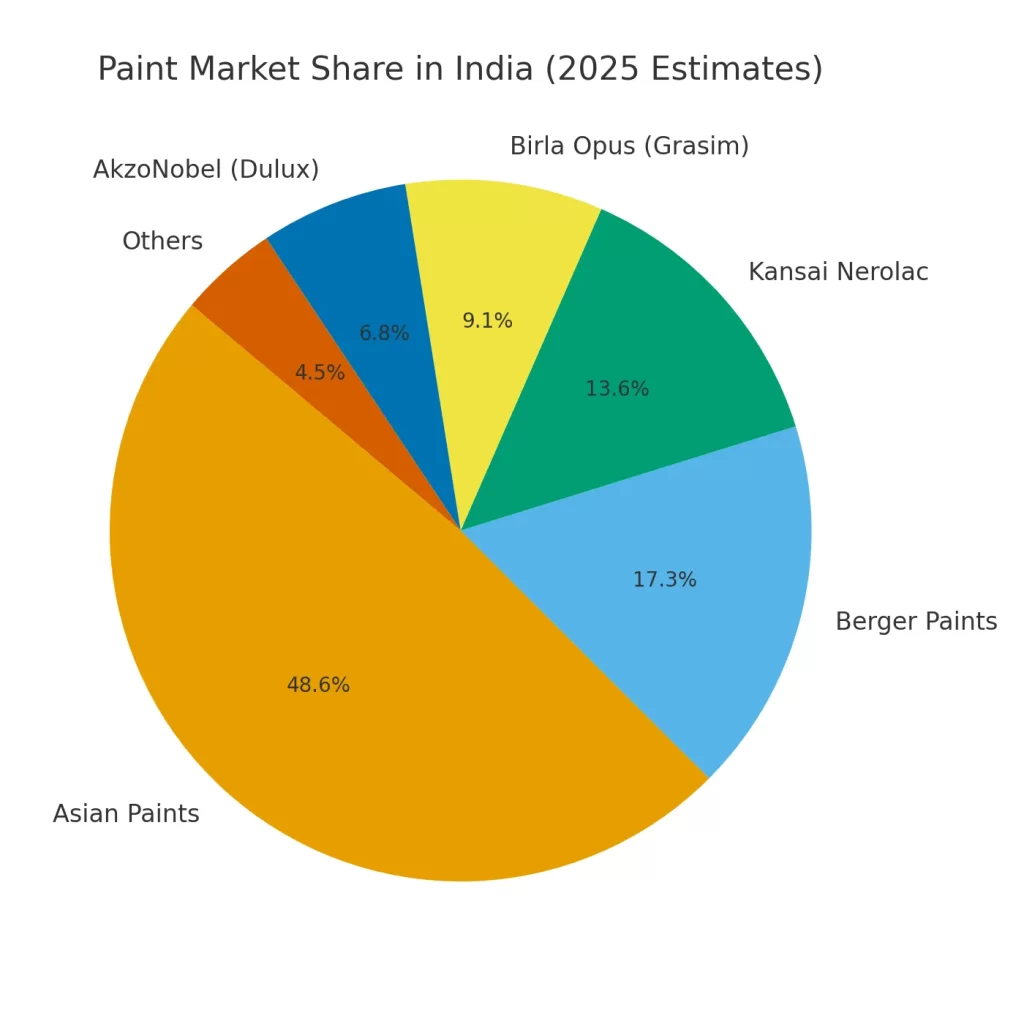
To see why this market is irresistible, you need only glance at the scoreboard. Asian Paints, the household name, controls more than half the market. For decades, it has defended this dominance with a powerful dealer network and unbeatable brand recall. Close behind are Berger Paints, Kansai Nerolac, and Akzo Nobel (Dulux), who together carve up another big slice. On the surface, it looks like a closed club. But even the strongest walls develop cracks. Asian Paints’ share has inched down from earlier peaks, and customers are becoming more adventurous with brands and finishes. Birla sees this as its opening—not to nibble at the edges, but to stake a serious claim.
Market Growth
Here’s the real kicker: this isn’t just a large market, it’s a fast-growing one. Worth more than ₹62,000 crore in 2025, India’s paints industry is expanding at 8–10% annually—well above GDP growth. The drivers are everywhere. Cities are growing taller, villages are embracing branded paints over traditional lime wash, and homeowners are spending more on premium textures and eco-friendly finishes. Every new housing project, every urban renovation, every aspirational middle-class household adds fuel to this growth. For Birla, it’s like stepping into a river that’s already in full flow—all they need to do is jump in with a strong boat.
Also Read: Paint Wars of India: How Birla’s Bold Move is Shaking Up a Decades-Old Industry
Backward Integration – Complementing Grasim’s Chemicals Business
In addition to the obvious advantages, Birla has something most new entrants lack: a built-in advantage through its chemicals empire. Grasim Industries already produces caustic soda, epoxy resins, and vinyl acetate monomer (VAM)—all key ingredients in paints. In plain terms, Birla controls the raw materials before they even reach the factory. That means cost savings, pricing power, and less vulnerability to global supply shocks. Competitors like Asian Paints spend heavily to secure these inputs, but Birla can pull them from its own backyard. It’s a classic case of backward integration turning into a competitive weapon.
Telecom Woes – The Vodafone Idea Factor
If paints are the bright new canvas, telecom is the blot on Birla’s balance sheet. Vodafone Idea, once a promising bet, has become a financial sinkhole. Debt of over ₹2 lakh crore, declining subscriber numbers, and relentless competition from Jio and Airtel have left the business gasping for survival. Despite government lifelines, the turnaround story hasn’t materialized. Investors have grown impatient. Against this backdrop, the paints foray is more than diversification—it’s reassurance. Birla is signaling that it’s not chained to a failing sector, and that it’s ready to redirect resources into businesses that actually grow and deliver profits.
Entry With Scale – ₹10,000 Crore Bet
Most companies dip a toe before diving. Birla, true to its style, has chosen to cannonball straight into the pool. With over ₹10,000 crore earmarked for plants, R&D, and distribution, this isn’t a tentative experiment. It’s a statement of intent. Large, automated plants are already on the drawing board, aimed at giving Birla the capacity to serve both metros and small towns from the outset. The sheer scale echoes Reliance’s Jio strategy in telecom—build big, build fast, and leave no doubt that you’re here to stay. For dealers and distributors, that kind of commitment is hard to ignore.
Diversification Strategy
For the group, paints aren’t just about color on walls—they’re about balance on books. The Aditya Birla portfolio is dominated by cyclical industries like cement, aluminum, and textiles. When prices crash, so do profits. Paints are different. They’re brand-led, consumer-driven, and relatively insulated from global commodity swings. Every festive season, every wedding, every house renovation pushes demand. By adding paints, Birla tilts its empire a little more toward consumer businesses, complementing its strengths in cement and chemicals. It’s a play that makes the group less vulnerable and more in sync with India’s rising consumption wave.
Also Read: A Paint Industry Revolution: Birla vs. Asian Paints Begins
Challenges Ahead
Breaking into paints isn’t as simple as splashing color on a wall. The biggest moat isn’t factories—it’s distribution. Asian Paints has spent decades cultivating dealers, ensuring every small-town shopkeeper prefers its cans over others. Loyalty runs deep in this business. For Birla to carve space, it will need to spend aggressively on dealer incentives, advertising campaigns, and customer trust. Then there’s the supply chain challenge: paints need to be available in thousands of shades, across thousands of outlets, with zero delays. Execution, not ambition, will determine if Birla becomes a genuine challenger or just another hopeful entrant.
Future Outlook
Industry watchers believe the battle will heat up in the coming decade. Asian Paints will fight hard to defend its turf, while Birla’s financial muscle and raw material advantage make it a credible contender. Over time, we could see a market that’s no longer a one-horse race. For Birla, success won’t happen overnight, but if it chips away steadily, it could emerge as a long-term rival in the way Reliance disrupted telecom or retail. Investors, meanwhile, are already taking notice—seeing paints not as a side venture, but as a future flagship.
New Canvas
The Aditya Birla Group’s entry into paints is more than a ₹10,000-crore project—it’s a signal of intent. It’s about rewriting the group’s growth story, easing away from struggling telecom, and stepping confidently into a sector built on consumer aspiration. Yes, the hurdles are high. Yes, incumbents are formidable. But Birla’s mix of chemicals, capital, and courage gives it an edge worth watching. In plain words, the group isn’t just painting walls—it’s painting its future.
READ MORE ON