


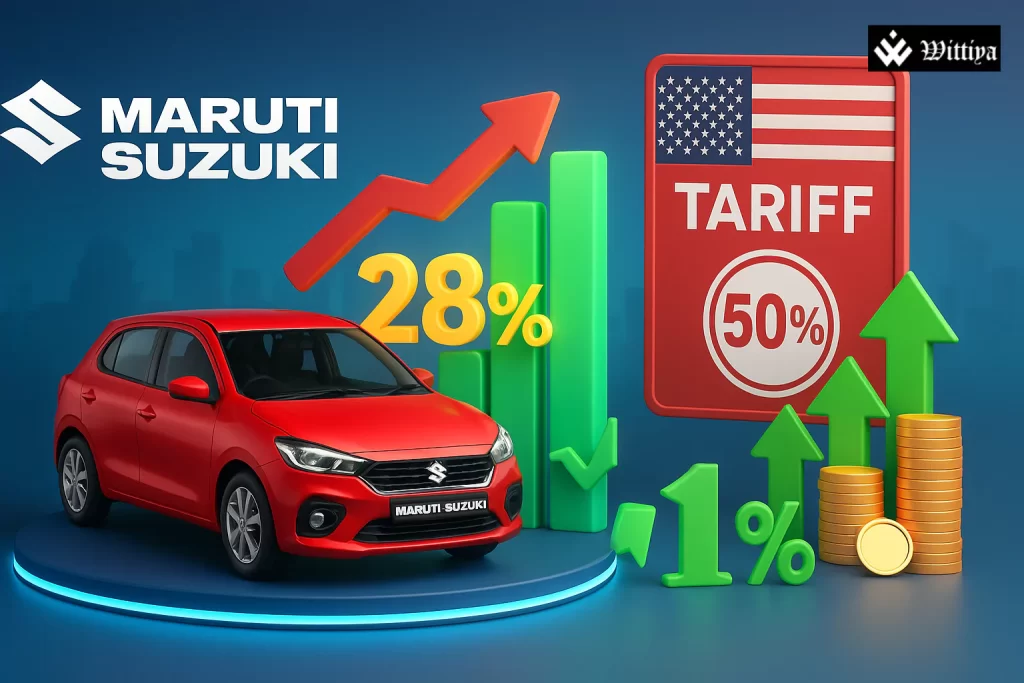
Top car manufacturer India, Maruti Suzuki, has requested the government to lower the GST rate on small cars as the economic situation is getting tighter due to US tariffs. Chairman RC Bhargava explained the necessity of tax relief to protect the demand.
India GST Cut On Cars
India’s car industry is going through a tough time. The chairman of Maruti Suzuki, RC Bhargava, called on the government to lower the GST rate for small cars. At the Maruti AGM, Bhargava said that if the US tariffs continue, the demand for Indian cars will be affected, as Indians will have less purchasing power, thus the relief of taxes will be very important to keep the automobile industry going.
Punishing US tariffs will make a lower percentage of the India’s population to have the purchasing power, Bhargava said in his speech at the company’s Annual General Meeting (AGM), while urging that a cut in the Goods and Services Tax (GST) rate on small cars is the only way to ‘keep the show on the road’.
The request follows the report from Reuters on August 18, 2025, that the Government of India recommended a reduction of GST on small cars from 28% to 18%. According to the news, this recommendation is part of the broader plan of Prime Minister Narendra Modi to “Redesign India’s Taxation Architecture,” which he announced in his Independence Day address.
Also Read: India Tariff Risk Outlook
US Tariffs Disrupt Indian Industries
The United States slapped a 50% tariff on clothes, jewelry, shoes, sports products, furniture, and chemicals exported from India, effective August 27. The sectors in question are small exporters and small workers, who create a large customer base for Maruti Suzuki, the company.
Bhargava explained that lower demand in the auto-industry is the ultimate consequence of tariffs on even the smallest of the Indian exporters. The decrease in export competitiveness is likely to reduce disposable income in households, thereby, the demand for small cars will also go down — i.e. the market segment where Maruti Suzuki had been most vibrant over the years.
Government Push for GST Reforms
The Indian car industry is monitoring the government’s moves anxiously as it is about to implement the largest tax restructuring since 2017. Besides the automobile sector, reforms are also anticipated in consumer goods and insurance. The insurance sector may see the rates going from the current 18% to 5% or even zero, especially in the case of health and life insurance premiums.
However, for the car industry, it is the proposal for cutting GST on small cars that is the game-changer, as it has the potential to reduce retail prices and invigorate the demand. Because auto sales are one of the major contributors to India’s GDP and the employment level, this decision is considered to be a powerful support measure against the present global trade uncertainties.
Also Read: Maruti Suzuki eVitara Set for Production and Export to 100 Countries
Financial and Market Implications
If the GST rate is lowered, consumer sentiment, particularly in middle-class households, is likely to improve. By setting the GST rate at 18%, the car prices are expected to be lowered by almost 8–10%, which will make the direct affordability of cars increase. As a result, not only the car companies like Maruti Suzuki will profit from it, but the passenger vehicle sales will also be able to sustain their bull run in India.
Moreover, a sovereign rating upgrade for India by S&P Global earlier this year may be a good sign for capital inflows which in turn, could support the government’s reform agenda. In contrast, the US tariffs still give rise to the external headwinds that might result in a slowing down of consumption and exports.
Industry Outlook
The nearest future is going to be very decisive for the government as it will have to work out the details of the GST reform and make an evaluation of the trade disruptions. In the event of October implementation, the tax reduction would be able to release the producers and consumers just in time. To Maruti Suzuki, the matter of small car sales is still at the center of Bhargava’s demand for fiscal measures to prop up India’s automobile sector and the budgetary policymaking’s urgency.
Q1: Why is Maruti Suzuki seeking lower GST on cars?
Maruti Suzuki would like lower GST on small cars so that the decreased demand due to the US tariffs affecting Indian industries can be compensated.
Q2: What GST changes is the Indian government proposing?
The government has proposed the reduction of GST on small cars from 28% to 18% and is also considering a cut in insurance GST from 18% to 5% or even lower.
Q3: How do US tariffs affect India’s auto industry?
The US tariffs make it difficult for Indian exporters to sell their products leading to the decrease of the income level of workers who are the potential buyers of the cars and hence the demand for automobiles gets weakened.
READ MORE ON