


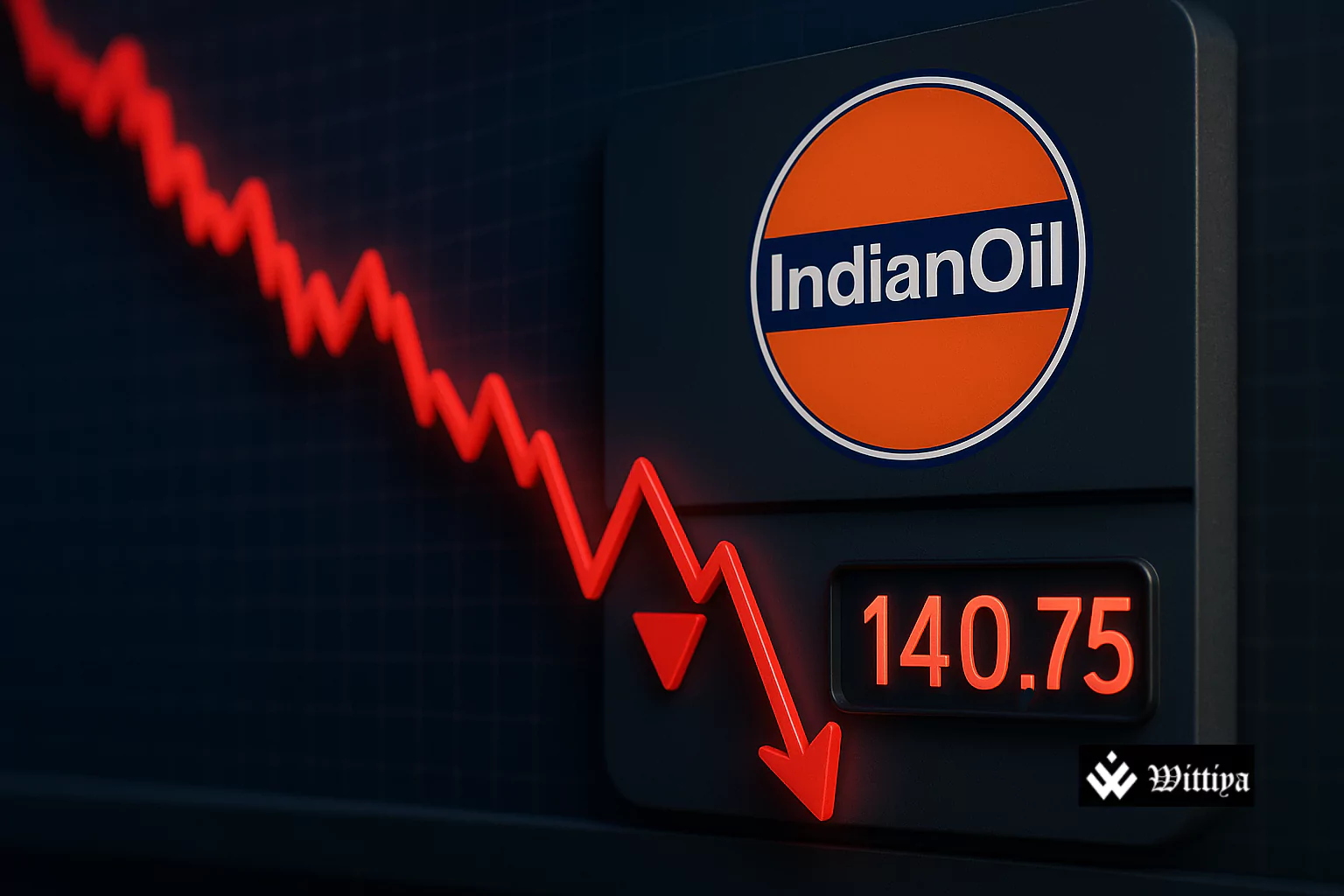
Indian Oil Corporation shares dipped ahead of Q1 FY26 results, with analysts expecting strong profit growth despite concerns over refining margins and sales decline.
Indian Oil Corporation Limited (IOC), India’s largest public sector oil refining and marketing company, witnessed a mild decline in its share price ahead of its Q1 FY26 results. The stock slipped over 1% to hit the day’s low of ₹140.75 on the BSE after opening at ₹142.55 apiece. Despite expectations of a sharp profit surge, the stock traded under pressure as investors stayed cautious before the earnings announcement.
Market analysts project IOC’s Q1 net profit to rise significantly, supported by improved operating performance. Projections indicate a potential surge of more than 250% year-on-year in profit after tax, with strong EBITDA growth compared to both the previous quarter and last year. However, concerns over refining margins (GRMs) remain, as the company had previously benefited from exceptional gains that are unlikely to repeat this quarter.
Also Read: Made in India, Taxed in America: Which Indian Sectors Will Bleed the Most?
On the revenue front, IOC’s net sales are expected to decline modestly both year-on-year and quarter-on-quarter. Analysts attribute this to weaker crude oil prices and a correction in global benchmarks, though the impact has been partially offset by an increase in domestic LPG prices.
From a technical perspective, IOC stock is currently retesting its breakout levels after a 143-day cup-and-handle pattern. Experts highlight that the retracement has occurred on relatively lower volumes, a sign often seen in healthy bullish consolidations. This indicates that selling pressure may be limited, with strong support likely in the ₹135–₹140 range. Positional investors are eyeing a potential rebound towards the ₹171 mark in the coming weeks.
As a Maharatna PSU, IOC continues to play a pivotal role in India’s energy sector, and its Q1 FY26 performance will be closely watched to gauge earnings resilience amid fluctuating crude oil prices and evolving domestic fuel policies.
READ MORE ON