


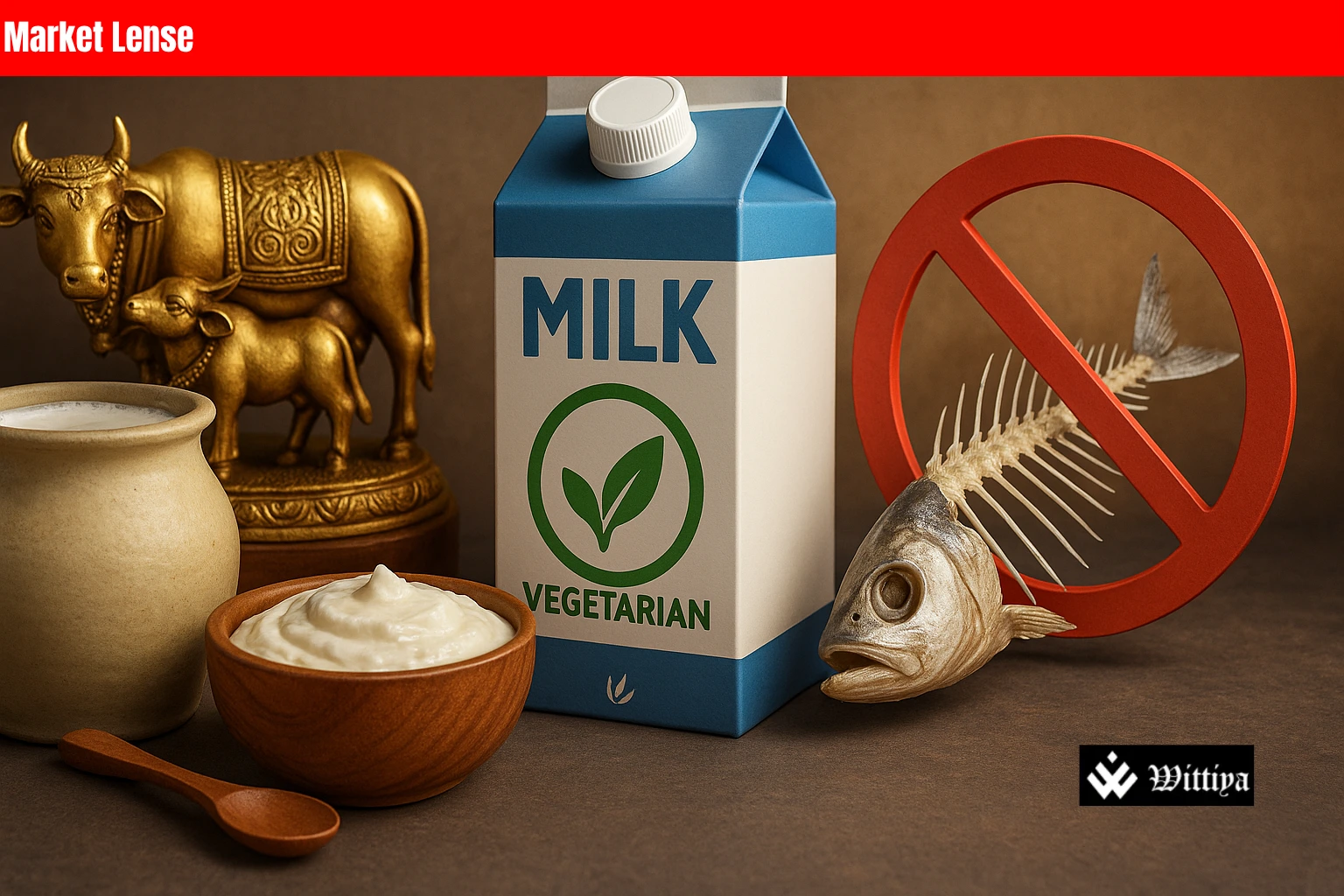
The debate around “non-veg milk” has resurfaced as India and the U.S. work toward deeper trade ties. At the center is the Indian objection to dairy products from animals fed non-vegetarian inputs like bone or fish meal—a practice common in the U.S. This article unpacks how cultural values, religious sensitivities, and economic interests collide in shaping India’s evolving stance. It also explores how resolving this issue could unlock broader trade deals, offering strategic wins for both countries without compromising domestic sentiments.
India’s dairy industry, steeped in tradition and religious sensitivities, has unexpectedly become a key discussion point in high-level trade negotiations between India and the United States. The term “non-veg milk”, unfamiliar in much of the world, has gained renewed attention as both nations work toward resolving long-standing trade barriers. At its heart lies a fundamental disagreement about what constitutes “pure” milk and the cultural meaning attached to its production.
What Is “Non-Veg” Milk Anyway?
In the Indian context, “non-veg milk” refers to milk sourced from animals that are fed feed containing animal-derived ingredients—such as bone meal, fishmeal, or blood meal. While such feed practices are widespread across the global dairy industry, they clash with India’s unique vegetarian ethos, especially among Hindus and Jains.
For Indian consumers, milk is not merely a dietary staple; it’s a symbol of purity, wellness, and sanctity. The idea that cows may have been fed non-vegetarian inputs—even if indirectly—makes the end product deeply problematic for large segments of the population. This issue is not about animal cruelty or nutritional content but rather about cultural acceptability. In a country where “vegetarian” often extends to how animals are raised, the concept of “non-veg milk” becomes more than semantics—it becomes political.
Also Read: With Deadline Near, India and US Rush to Finalize Trade Pact
Why Is It in the Headlines Now?
The debate over non-veg milk has resurfaced because India has agreed to allow limited imports of U.S. dairy products as part of broader trade negotiations. The U.S. dairy lobby has long sought access to the Indian market, but India resisted for years due to concerns over animal feed practices.
This time, however, the calculus has changed. Trade talks between the two countries have intensified, particularly in sectors like defense, semiconductors, and digital infrastructure. As a sign of goodwill and to remove one of the final roadblocks to deeper trade ties, India has shown openness to allowing dairy imports under strict conditions. These include mandatory labeling for vegetarian-fed dairy and quality assurance aligned with Indian standards.
The re-emergence of this issue underscores how trade policy is often driven not just by economics, but by cultural and political considerations.
The U.S. Perspective: It’s About Market Access
For the United States, India represents a billion-strong opportunity. With a growing middle class and rising demand for processed dairy products—such as cheese, protein supplements, and infant formula—India is a market too large to ignore.
The American dairy industry, backed by powerful cooperatives and trade associations, has consistently lobbied for access to Indian consumers. Until now, the biggest hurdle was India’s insistence on strict vegetarian sourcing. But with negotiations opening up and India showing flexibility, U.S. producers sense an opportunity—provided they can navigate India’s cultural sensitivities and labeling requirements.
This move is seen as part of a broader U.S. strategy to deepen its trade ties with India and reduce dependency on China in the Asia-Pacific region.
Also Read: 14 Countries. One Tariff Policy. What Is Trump’s Next Move?
India’s Balancing Act: Cultural Values vs Global Trade
India’s leadership faces the delicate task of balancing global ambitions with domestic values. On one hand, allowing U.S. dairy imports helps India negotiate more favorable terms in other strategic sectors. On the other hand, caving to foreign pressure on something as symbolically significant as milk could trigger backlash from both consumers and political constituencies.
Religious groups, dairy cooperatives, and consumer rights advocates have raised concerns that importing dairy from animals fed non-vegetarian feed violates India’s cultural norms. Additionally, there is the economic fear that large-scale imports could hurt small dairy farmers, who dominate India’s decentralized dairy industry.
The government’s strategy, therefore, appears to be one of selective allowance with strict labeling and oversight—a middle path that acknowledges global trade realities without undermining domestic values.
What’s the Economic Significance?
Though seemingly narrow, the resolution of this issue has broader trade implications. For India, settling the dairy debate removes a key obstacle to unlocking larger trade and investment opportunities with the U.S.
For the U.S., even limited access to Indian dairy markets is a symbolic win that opens doors for expanded bilateral negotiations. Beyond dairy, the outcome of this dispute sets a precedent for how India may handle future conflicts between cultural sensitivities and trade liberalization.
India’s insistence on transparency through labeling, and the willingness of the U.S. to comply, suggests a maturing of trade diplomacy—where both sides prioritize pragmatism over posturing.
The Road Ahead: Labeling, Logistics & Local Politics
While the headlines may fade, the underlying complexities will persist. Enforcement of labeling norms will be crucial. Consumers must be able to clearly distinguish between dairy that complies with Indian vegetarian standards and products that don’t.
Moreover, state governments and local dairy cooperatives will remain powerful voices in this discussion. Several Indian states have already expressed reservations about allowing imports, even with labeling. Political narratives tied to cow protection and rural livelihoods may gain traction, especially in election cycles.
The logistics of tracking, verifying, and enforcing feed-origin compliance at the border will also require a strong regulatory framework.
Final Takeaway
The debate over “non-veg milk” is far more than a quirky trade anomaly—it’s a reflection of how deeply culture, identity, and economics are intertwined in the modern global order. As India and the U.S. continue to deepen their trade partnership, this episode serves as a reminder that mutual respect for values and consumer choice will remain key to sustainable cooperation.
India’s ability to uphold its cultural sensitivities while embracing pragmatic trade decisions could well shape its role as a confident, values-driven global player in the years ahead.
READ MORE ON